

Trump’s friends, enemies, and enablers.
Photo-Illustration: Intelligencer; Photo: Supreme Court of the United States
As the tumultuous first year of Donald Trump’s second term as president approaches its end, it’s difficult to assess his successes and his failures. For one thing, his governing strategy has been all but unprecedented. Most presidents who have just won an election are forced to choose whether they want to cash in their political chips to get big things done or build up political capital for future elections. Trump has chosen the first fork in the road with an audacious policy agenda and massive expansions of presidential power. But at the same time, he’s trying to make future elections more promising not by improving his lagging popularity but by rigging the landscape via aggressive gerrymandering and efforts to manipulate voting rules. Because nearly all his power grabs have drawn legal challenges, much of his legacy remains up in the air, slowly moving through the federal court system toward reckonings in a Supreme Court that Trump has done much to shape.
What’s made this situation especially hard to figure out is the Supreme Court’s new habit of relying heavily on its “shadow docket.” This involves temporary rulings on emergency petitions, sometimes from the administration as it seeks relief from lower-court judges who have thwarted Trump’s high-speed agenda, and sometimes from Trump opponents who are trying to slow down the locomotive of unparalleled executive actions. So the state of play on any given issue depends on the interplay of both temporary and regular Supreme Court decisions with the implications of “shadow docket” rulings often clouded by terse orders with no explanation of the legal reasoning. It’s quite a quagmire.
The most familiar set of issues facing the Supreme Court, mostly because litigation on them began early in 2025, involves assertions of presidential authority over matters normally consigned to Congress, the courts, or independent federal agencies. Typically, the administration has found some obscure emergency power intended for situations like wars or natural disasters and asserted the president’s exclusive right to determine when and to what it applies. Accordingly, in 2025 Trump has declared nine separate “emergencies” that give him and his hirelings extraordinary powers over tariffs, exclusion or deportation of refugees, and energy policy, among other things.
Reinforcing these claims of executive preeminence has been a general argument, to which Supreme Court conservatives are receptive, that the president deserves great deference to his actions in any area affecting foreign relations or national security. Trump’s lawyers, for example, claim tariffs are so entwined with diplomacy that restricting his ability to obtain leverage through “trade deals” would hamstring his ability to conduct foreign relations. Similarly, they argue that border control and the immigration policies necessary to maintain it are inherently national-security matters where Congress and the courts should give the chief executive maximum leeway.
Big upcoming Supreme Court decisions involving executive authority include (1) a batch of tariffs cases that will determine whether the centerpiece of Trump’s economic policy will stand or fall; (2) appeals from lower-court decisions restricting the president’s power to arbitrarily deploy military units in U.S. cities; (3) a welter of immigration cases testing the administration’s power to cancel refugee status for hundreds of thousands of migrants, deport “illegals” to countries other than their own, and cancel “birthright citizenship” for children of undocumented immigrants born in this country; and (4) a test of the outer limits of presidential power over executive agencies, especially those created to be independent, like the Federal Reserve Board, which Trump wants to control personally.
In a very real sense, the Supreme Court will determine in the coming weeks and months whether a president determined to act outside traditional executive boundaries can or cannot be meaningfully restrained by Congress or the judiciary. As Christian Farias put it in New York, if the Court acts quickly and decisively in Trump’s favor, it could in just three months effectively make him king.
Aside from the scope of Trump’s powers, the Supreme Court will also have a lot to say about their duration by granting or denying him the power to rig the midterms and perpetuate Republican trifecta control of the federal government. That could make the difference between the Trump 2.0 train roaring toward the end of his presidency at full throttle and a chastened lame-duck president facing obstacles to his reign from a Congress partially controlled by the opposition.
Most immediately, the Supreme Court will decide whether a lower-court decision scrapping his first and most audacious gerrymandering bid will stand. This summer, Trump abruptly ordered Texas to conduct a rare mid-decade remapping of U.S. House districts to help insulate the GOP majority from the midterm electorate. Texas complied, but its new map giving Republicans five new districts was based on a blatantly racial justification provided by Trump’s Justice Department, which led to the adverse judicial ruling on November 18. Now Trump’s lawyers are asking the Supreme Court to intervene and reimpose the gerrymandered map on grounds that the lower court acted too late in the election cycle. The Court will also review a Justice Department suit claiming that the retaliatory Democratic gerrymander approved by California voters on November 4 was unconstitutionally racial in its motivations. If it chose to rule for Trump in both cases, the Supreme Court could swing the midterm map by as much as ten net House seats, aside from its effect on other gerrymandering disputes that might arise. That could be enough to protect the GOP majority in the House.
But the biggest blow to the midterm electorate’s ability to restrain Trump could come from a different case involving Louisiana, in which the Supreme Court has been invited to invalidate the minority vote rights guarantees in Section 2 of the Voting Rights Act of 1965. That case has been argued and reargued before the Court, and a decision could arrive at almost any time. If the Supreme Court acts quickly and sweeps away what’s left of the VRA, it could produce a wave of instant gerrymanders in Republican-controlled states that would be free to dismantle House (and state legislative) districts designed to give Black and Latino citizens some minimal representation. In turn, that could tilt the national map far enough in the GOP’s direction that only a major Democratic wave could dislodge Trump’s total control of Washington.
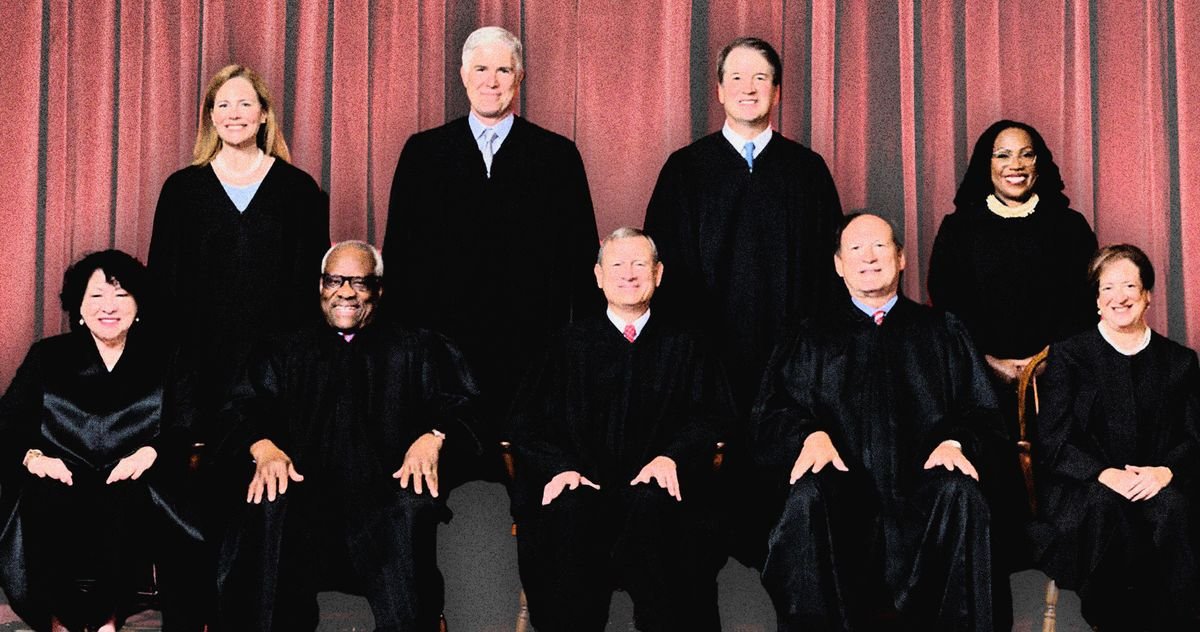
It’s generally assumed that Justices Samuel Alito and Clarence Thomas will give Trump virtually everything he wants and that Justices Sonia Sotomayor, Elena Kagan, and Ketanji Brown Jackson will dissent powerfully. But three of the remaining Justices (Neil Gorsuch, Brett Kavanaugh, and Amy Coney Barrett) owe their lifetime appointments to Trump, and Chief Justice John Roberts is the jurist who placed this president above the law in last year’s big immunity case.
If the Supreme Court’s conservative majority does give the 47th president a helping hand in expanding and maintaining his power, Democrats might be forced to reconsider their current tendency to subordinate “threat to democracy” warnings to crass material considerations in their midterm messaging. Yes, Trump’s economic policies and broken promises on “affordability” are damaging his and his party’s popularity significantly. But if he’s given royal authority to run wild and the ability to overcome any popular backlash at the polls, then the bad times could continue to roll for at least three more years.
