
December 11, 2025

How many times as a younger gardener did I pore over photos and descriptions of plants in Texas-friendly gardening books, circling the darlings I wanted to try? Thumbing through the Wasowskis’ Native Texas Plants and the Ogdens’ Waterwise Plants for Sustainable Gardens, I’d add a rainbow’s worth of sticky notes for easy reference. This year, Andrea DeLong-Amaya’s Texas Native Plant Primer offered another opportunity to circle interesting plants that can handle our extreme climate — even if my own garden is pretty full at this point.
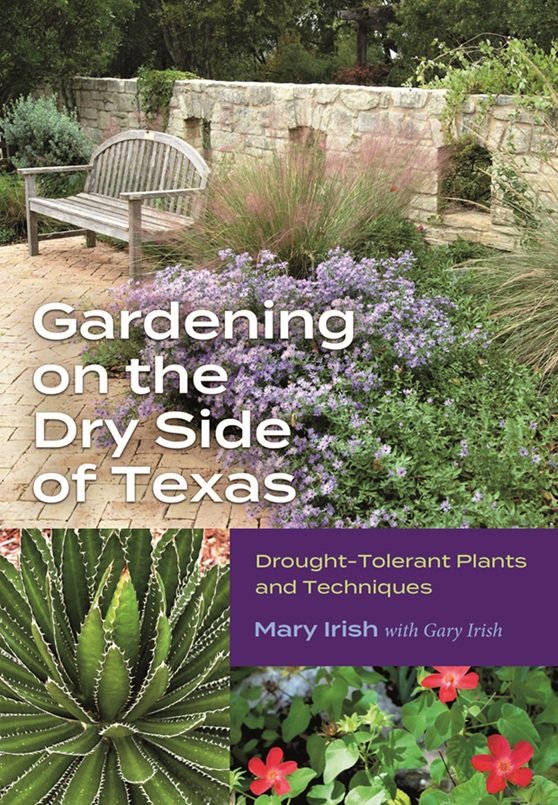
But there are always new and new-to-Texas gardeners. And a new gardening book should be added to their bookshelves. I just finished Gardening on the Dry Side of Texas: Drought-Tolerant Plants and Techniques by the late Mary Irish, coauthored with her husband, Gary Irish, which came out this spring from Texas A&M University Press. It’s an excellent resource.

It’s hard to write a book that adequately covers the whole of this vast and varied state, as Irish knew well. So for this book, she focused on the broad swath along the I-35 corridor, encompassing Dallas–Fort Worth, Austin, and San Antonio, and down to the Rio Grande Valley — a region that receives between 20 and 40 inches of rain annually. It doesn’t include the wetter eastern side of Texas, nor the desert on the western side. Significantly, this is a populous region with “around twenty million people, out of a total state population of thirty million,” Irish writes. In other words, most Texans live in the area she’s covering — and it’s trending drier.
Now, the title is a little confusing. At first, I thought “the dry side of Texas” referred to West Texas — i.e., from Abilene to the Trans-Pecos and the Panhandle. Nope. It’s all about North, Central, and South Texas, where “the use of drought-adapted and native plants could, and we argue should, be the backbone of horticultural practice,” the Irishes write. They point to climate-change models predicting hotter summers and deepening droughts. Combined with a growing population, this means we need to landscape for better water thriftiness if we want to have water for drinking, bathing, and cooking.
Mary Irish was a horticulturist, consultant, educator, and the prolific author of 11 gardening books, including the lovely memoir A Place All Our Own. She was born in Texas but lived in Arizona for many years before returning to the San Antonio area, and she left her mark on the gardening culture of both states. Gary, her husband of 41 years, provided photographs for her books, and he coauthored at least four books with her. As he explains in the preface, Mary had written a draft of Gardening on the Dry Side of Texas when she passed away in 2021. Gary completed the book, and now it’s out — a fitting tribute to Mary’s legacy.

The book includes a brief discussion of the changing climate, a botany lesson in the ways that plants cope with heat and drought, how to get started in making a waterwise garden, irrigation tips, and other helpful info about gardening in the central swath of Texas. The bulk of the text, however, is Irish’s plant write-ups. Many are Texas natives, but by no means all. They’re organized into chapters on shrubs, perennials, trees, palms, vines, succulents and similar plants, grasses, bulbs, and — charmingly — “wonderful weeds.” An illustrative photo is included for each plant, along with common and botanical names, size, light requirements, and cold hardiness.
Each plant gets about a page of keen description, with Irish sharing how it grows, how it flowers, its native range, how and when to plant and prune it, and a brief anecdote about her experience with it. She also includes the meaning of its botanical (Latin) name — interesting for language lovers like myself, and a glimpse into the cultural perception or plant-explorer history of each plant.
At the back of the book, Irish provides additional planting and pruning information for woody plants, trees, shrubs, and perennials. Anyone gardening in the north-to-south midsection of Texas will be well served by this book.
The only downside is the price, which for a medium-size paperback is spendy at $55, although it’s currently listed for less on Amazon. It is a meaty paperback, however, and packed with solid information. It would make a nice gift for a new Texas gardener or any Texan exploring how to make their garden more waterwise. As Mary’s final book, it’s special in that way too.
Images from Gardening on the Dry Side of Texas courtesy of Texas A&M University Press. Disclosure: Texas A&M University Press sent me the book, and I reviewed it at my own discretion and without any compensation. This post, as with everything at Digging, is my personal opinion.
I welcome your comments. Please scroll to the end of this post to leave one. If you’re reading in an email, click here to visit Digging and find the comment box at the end of each post. And hey, did someone forward this email to you, and you want to subscribe? Click here to get Digging delivered directly to your inbox!
__________________________
Digging Deeper
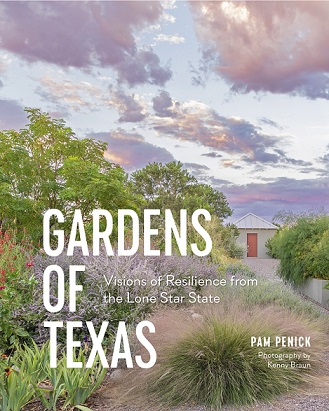
My new book, Gardens of Texas: Visions of Resilience from the Lone Star State, is here! Find it on Amazon, other online book sellers, and in stores everywhere. It’ll make a great holiday gift for anyone who loves gardens or the natural beauty of Texas. More info here.
Come see me on tour! I’ll be speaking and hosting book events across Texas this fall and into next spring to celebrate the release of Gardens of Texas. Join me to learn, get inspired, and say hello!
Learn about garden design and ecology at Garden Spark! I organize in-person talks by designers, landscape architects, authors, and gardeners a few times a year in Austin. Subscribe to Garden Spark by clicking here to email — subject line: SUBSCRIBE.
All material © 2025 by Pam Penick for Digging. Unauthorized reproduction prohibited.
