
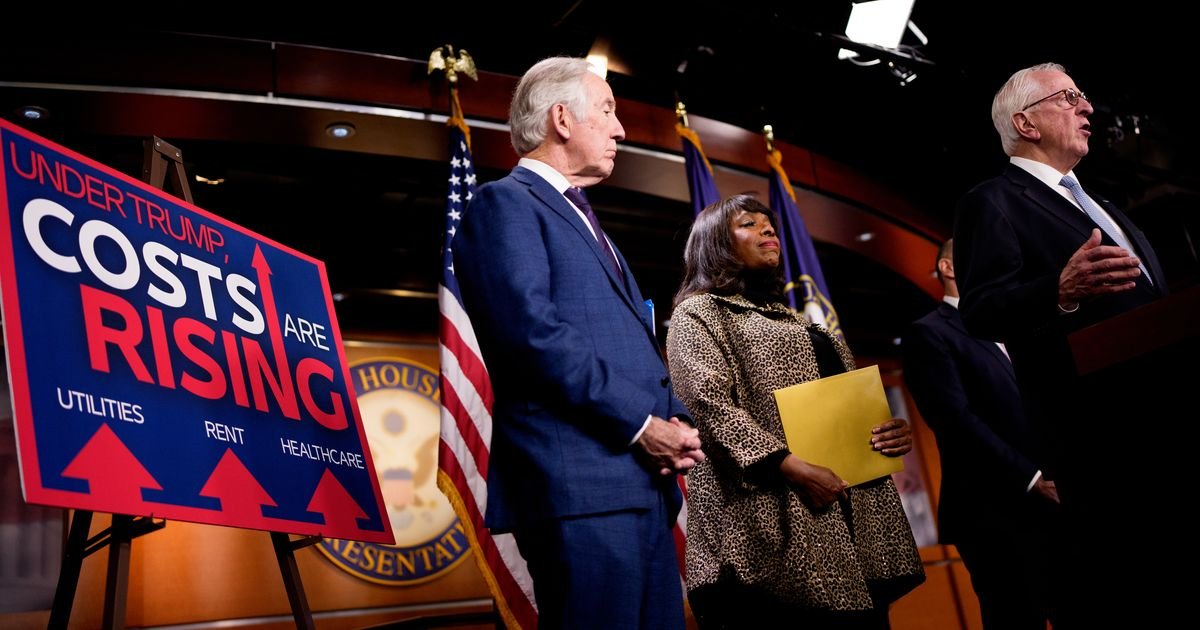

Congressional Democrats have their issue for 2026.
Photo: Andrew Harnik/Getty Images
One of the big political stories of 2025 was the Democrats’ search for a message that could bring their party back from its calamitous 2024 losses. They began with a lot of confusion and divisions. Some progressives wanted, as they have for many years, a “populist” economic message that bashed “oligarchs,” heartless corporations, and global elites. Some centrists wanted to begin the comeback by jettisoning “woke” cultural stances and paying much more attention to moderate-minded median voters. Everyone acknowledged that Joe Biden and then Kamala Harris had failed to fully comprehend the damage that persistent inflation was doing to voter perceptions of their competence and compassion. And there was a potential common ground between centrist advocates of an “abundance” agenda that would help Democrats get big things done that benefited regular folks in tangible ways, and progressive billionaire-bashers who also focused on helping people make ends meet, albeit through different measures.
It’s hard to identify the precise moment when these varying strands came together into a message and agenda on “affordability.” But a big breakthrough occurred on November 5, 2025, when centrist gubernatorial candidates in New Jersey and Virginia and one notable progressive mayoral candidate in New York all won smashing victories by focusing on the rising living costs that belied Trump’s 2024 promises that he would bring back pre-pandemic prices on virtually everything. It wasn’t working just in blue states and cities, either. In Georgia on that same day Democrats beat two incumbent Republican state public-service commissioners by holding them accountable for rising power bills. And the next month a lefty Democratic candidate in a special congressional election in deep-red Tennessee over-performed expectations with an “affordability” message, despite all kinds of problems with her record and issue positions.
With polls showing Trump’s job-approval numbers on handling inflation and managing the economy diving and his tariff initiatives getting much of the blame, it looked like Democrats had found their lightning in a bottle in a way that unified the party’s factions and also showed they had learned from the Biden-Harris-Walz debacle. Perhaps the best indication they were on to something special was the urgent concerns Republicans were starting to express about persistently high living costs. Even Trump seemed to be trying to get with the program, though he kept stepping on his own message by complaining that the economy was doing great, that restive voters were offensively ungrateful, and that the entire affordability issue was a “hoax.” It was beginning to look like Democrats were getting their mojo back, particularly after they triggered a government shutdown that proved they were willing to “fight Trump” on favorable ground (in this case, the “affordability” problem with health-care costs generally and Obamacare premium subsidies expiring in particular).
While Trump was experiencing the downside of being the party in power in a period when voters were unhappy with government’s performance, he also retained the ability to control public discourse by audacious actions that surprised the opposition and literally changed the subject of partisan debate. In fact, he’s done that twice in the past week, first with his military strike on Venezuela and then with his robust defense of an ICE agent who killed an unarmed civilian in Minneapolis, apparently for no good reason.
Neither development came out of nowhere, of course. The Venezuela action followed a long buildup of military forces in the waters near that country along with lethal attacks on alleged “drug boats” and wild threats against Nicolás Maduro for supposed “narco-terrorism.” And it also reflected a new national-defense strategy involving near-imperial U.S. hegemony over the Western Hemisphere. The killing in Minnesota was the inevitable product of Trump’s mass-deportation initiative with its reliance on terrorizing immigrant communities into “self-deportation” with thuggish tactics from armed and masked federal agents. It also stemmed from Trump’s decision to target Minnesota immigrants to exploit a child-care scandal linked to Somalis that happened on the watch of Democratic state and local officials.
But predictable as they might have been, both incidents unsettled Democratic hopes of spending 2026 talking about “affordability,” and spurred fears that Trump would drag them “off-message” onto potentially treacherous and even divisive ground. As Politico reported, some Democrats sought to quickly “pivot” from criticism of Trump’s adventure to their now-favorite preoccupation:
Across the country, candidates and lawmakers are slamming Trump’s decision to capture Venezuelan President Nicolás Maduro and are using the moment to hammer their domestic affordability message.
“Ohioans are facing higher costs across the board and are desperate for leadership that will help deliver relief,” former Sen. Sherrod Brown, who is running to reclaim his seat, said on X. “We should be more focused on improving the lives of Ohioans – not Caracas.”
The frame from Democrats shows how potent the party views affordability as an issue in the midterms, one that Trump and his team have grown increasingly preoccupied by after across-the-board losses in 2025.
Trump’s seizure of multiple news cycles to lord it over the hemisphere and endorse lethal law-enforcement policies also made it hard for Democrats to follow consultants’ advice to ignore his provocations as much as possible, noted The Hill:
Political strategists say Democrats running in competitive races in this year’s midterm elections for the House and Senate should steer clear of making President Trump the centerpiece of their campaigns.
While Trump’s approval ratings are low and Americans have been frustrated by his job performance in the first year of his second term, the strategists say the key to winning is to home in on economic issues — particularly affordability. …
It’s not as though Trump won’t be mentioned, people familiar with the strategy of the House Democrats’ campaign arm say. It’s that the president will be secondary to the primary focus of how Democrats can make the economy better.
Many rank-and-file Democrats reject this Trump-o-phobic approach. Some think Venezuela and ICE are big issues that must be confronted even if they’re “off-message” or believe Trump’s larger threat to democracy and traditional American values goes deeper than the wallet, and would exist even if life was “affordable” for most Americans. It’s a tension between cold calculations and red-hot emotional reactions to this president’s regular outrages that will likely continue in the opposition party so long as he is in office.
