
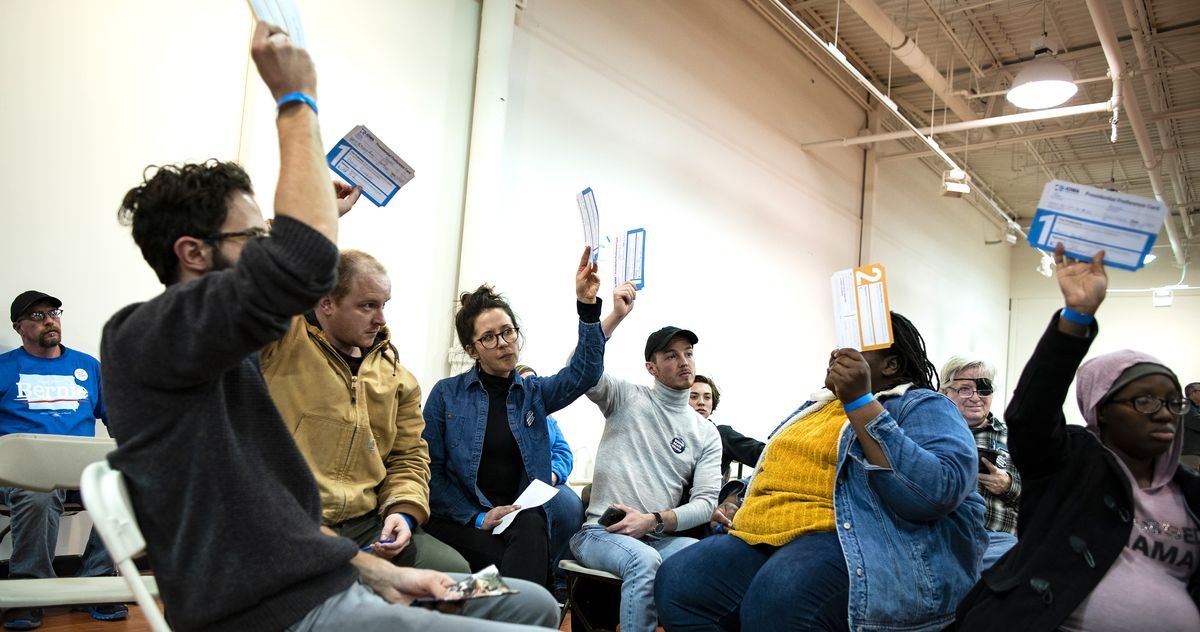

Bernie Sanders supporters hold up their presidential-preference cards during the Iowa caucuses on February 3, 2020.
Photo: Al Drago/Bloomberg/Getty Images
The first 2028 presidential primaries are just two years away. And for the first time since 2016, both parties are expected to have serious competition for their nominations. While Vice-President J.D. Vance is likely to enter the cycle as a formidable front-runner for the GOP nod, recent history suggests there will be lots of other candidates. After all, Donald Trump drew 12 challengers in 2024. On the Democratic side, there is no one like Vance (or Hillary Clinton going into 2016 or Joe Biden going into 2020 who is likely to become the solid front-runner from the get-go, though Californians Gavin Newsom and Kamala Harris lead all of the way too early polls.
But 2028 horse-race speculation really starts with the track itself, as the calendar for state contests still isn’t set. What some observers call the presidential-nominating “system” isn’t something the national parties control. In the case of primaries utilizing state-financed election machinery, state laws govern the timing and procedures. Caucuses (still abundant on the Republican side and rarer among Democrats) are usually run by state parties. National parties can vitally influence the calendar via carrots (bonus delegates at the national convention) or sticks (loss of delegates) and try to create “windows” for different kinds of states to hold their nominating contests to space things out and make the initial contests competitive and representative. But it’s sometimes hit or miss.
Until quite recently, the two parties tended to move in sync on such calendar and map decisions. But Democrats have exhibited a lot more interest in ensuring that the “early states” — the ones that kick off the nominating process and often determine the outcome — are representative of the party and the country as a whole and give candidates something like a level playing field. Prior to 2008, both parties agreed to do away with the traditional duopoly, in which the Iowa caucuses and New Hampshire primary came first, by allowing early contests representing other regions (Nevada and South Carolina). And both parties tolerated the consolidation of other states seeking influence into a somewhat later “Super Tuesday” cluster of contests. But in 2024 Democrats tossed Iowa out of the early-state window altogether and placed South Carolina first (widely interpreted as Joe Biden’s thank-you to the Palmetto State for its crucial role in saving his campaign in 2020 after poor performances in other early states), with Nevada and New Hampshire voting the same day soon thereafter. Republicans stuck with the same old calendar with Trump more or less nailing down the nomination after Iowa and New Hampshire.
For 2028, Republicans will likely stand pat while Democrats reshuffle the deck (the 2024 calendar was explicitly a one-time-only proposition). The Democratic National Committee has set a January 16 deadline for states to apply for early-state status. And as the New York Times’ Shane Goldmacher explains, there is uncertainty about the identity of the early states and particularly their order:
The debate has only just begun. But early whisper campaigns about the weaknesses of the various options already offer a revealing window into some of the party’s racial, regional and rural-urban divides, according to interviews with more than a dozen state party chairs, D.N.C. members and others involved in the selection process.
Nevada is too far to travel. New Hampshire is too entitled and too white. South Carolina is too Republican. Iowa is also too white — and its time has passed.
Why not a top battleground? Michigan entered the early window in 2024, but critics see it as too likely to bring attention to the party’s fractures over Israel. North Carolina or Georgia would need Republicans to change their election laws.
Nevada and New Hampshire have been most aggressive about demanding a spot at the beginning of the calendar, and both will likely remain in the early-state window, representing their regions. The DNC could push South Carolina aside in favor of regional rivals Georgia or North Carolina. Michigan is close to a lock for an early midwestern primary, but its size, cost, and sizable Muslim population (which will press candidates on their Gaza War stance) would probably make it a dubious choice to go first. And recently excluded Iowa (already suspect because it’s very white and trending Republican, then bounced decisively after its caucus reporting system melted down in 2020) could stage a “beauty contest” that will attract candidates and media even if it doesn’t award delegates.
Even as the early-state drama unwinds, the rest of the Democratic nomination calendar is morphing as well. As many as 14 states are currently scheduled to hold contests on Super Tuesday, March 7. And a 15th state, New York, may soon join the parade. Before it’s all nailed down (likely just after the 2026 midterms), decisions on the calendar will begin to influence candidate strategies and vice versa. Some western candidates (e.g., Gavin Newsom or Ruben Gallego) could be heavily invested in Nevada, while Black proto-candidates like Kamala Harris, Cory Booker, and Wes Moore might pursue a southern primary. Progressive favorites like AOC or Ro Khanna may have their own favorite launching pads, while self-identified centrists like Josh Shapiro or Pete Buttigieg might have others. Having a home state in the early going is at best a mixed blessing: Losing your home-state primary is a candidate-killer, and winning it doesn’t prove a lot. And it’s also worth remembering that self-financed candidates like J.B. Pritzker may need less of a runway to stage a nationally viable campaign.
So sketching out the tracks for all those 2028 horses, particularly among Democrats, is a bit of a game of three-dimensional chess. We won’t know how well they’ll run here or there until it’s all over.
