
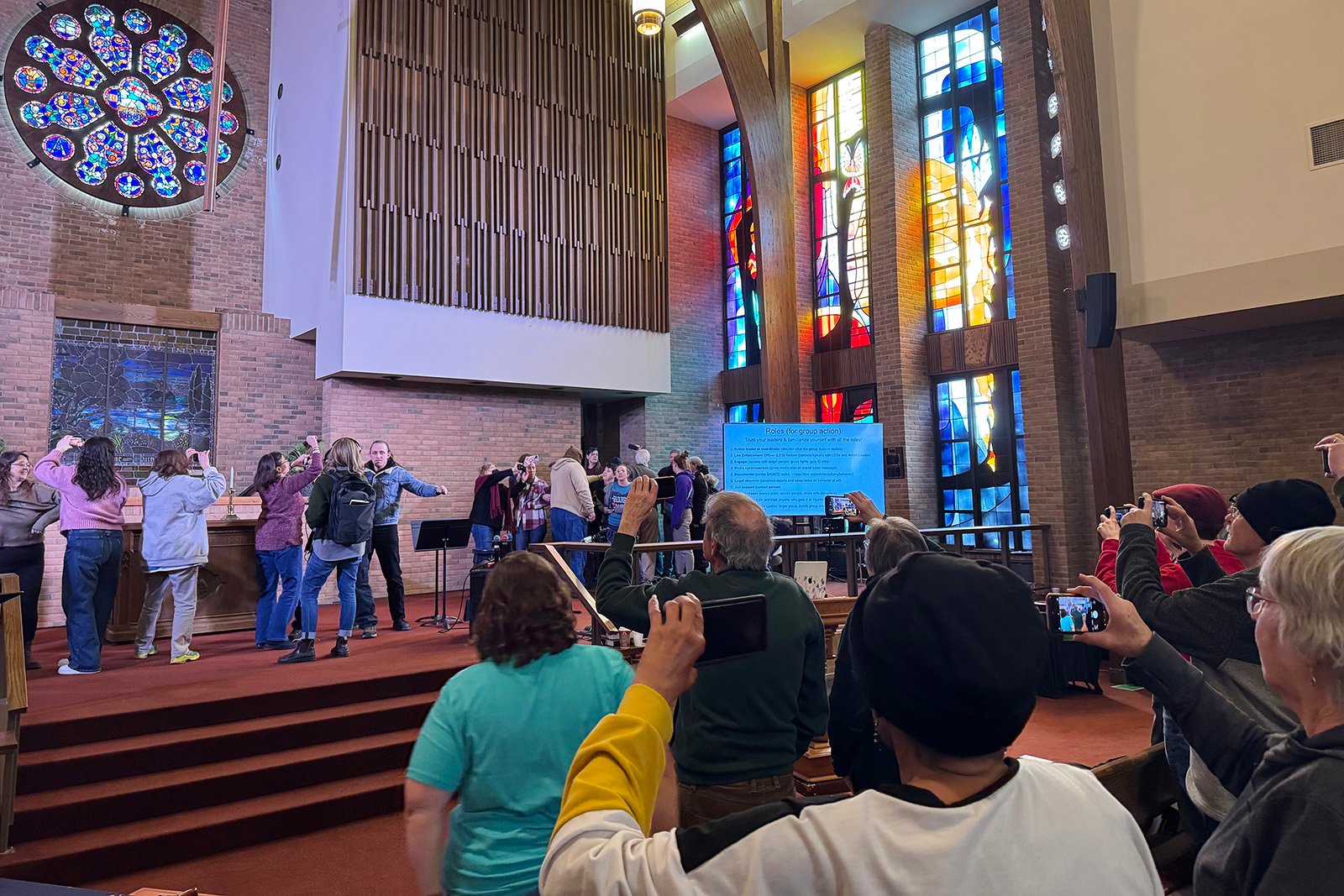
SPRINGFIELD, Ohio (RNS) — “We have orders of deportation,” said a volunteer in a raised voice, posing as an Immigration and Customs Enforcement agent and pounding on the sanctuary door. “What you’re doing is harboring.”
Inside the sanctuary, hundreds of trainees blocked the large wooden double doors. One called out, “We’re exercising our First Amendment right to freedom of worship.”
The handful of faux ICE agents moved to a different entryway. As they pried open the side door to the sanctuary, some trainees held up phones to record the encounter while others blew whistles.
The scenario was part of a roleplay exercise at a rapid response training in Springfield, Ohio, on Saturday (Jan. 24). Despite the winter storm in the forecast, nearly 200 people from in and around Springfield gathered at Central Christian Church for the event organized by G92, a new Springfield-based coalition of pro-immigrant churches and advocates named after the 92 times the Hebrew word “ger,” which means stranger or sojourner, appears in the Hebrew Bible.
“For many people, this isn’t just a political issue, it’s also a spiritual issue,” said Central Christian pastor and G92 founder The Rev. Carl Ruby as he welcomed trainees earlier that day.
Community organizers at the G92 training told attendees they’d received “verified reports” from “many sources” that ICE would be arriving in Springfield on Feb. 3 or 4, and “staying for 30 or more days.” The timing coincides with the potential end of temporary protected status for Haitians — roughly 12,000 to 15,000 of whom call Springfield home.
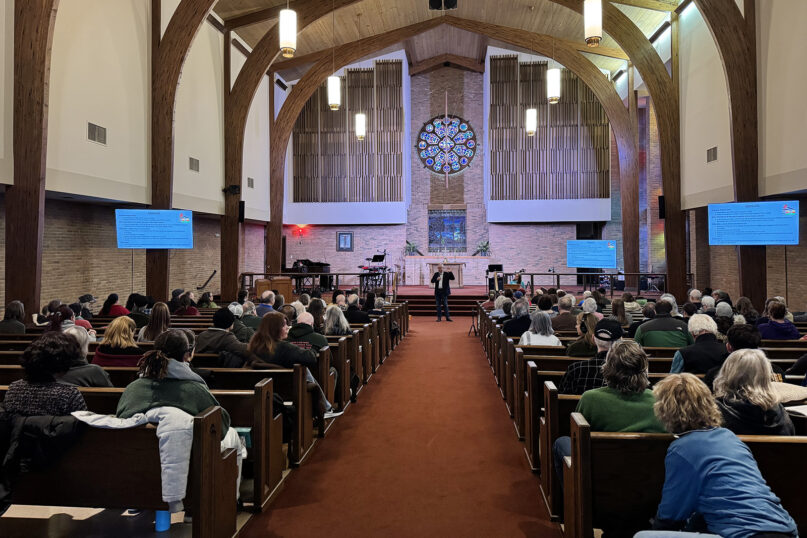
The Rev. Carl Ruby, center, speaks to trainees at Central Christian Church, Saturday, Jan. 24, 2026, in Springfield, Ohio. (RNS photo/Kathryn Post)
It’s a community that has already faced national scrutiny when, in 2024, then-candidate Donald Trump and his running partner, JD Vance, spread false claims during their campaign, saying Springfield’s Haitian migrants were “eating the pets of the people that live there.”
Unless delayed by a court ruling, Haitians’ TPS, which grants them temporary legal stay and work authorization, is scheduled to terminate on Feb. 3, leaving the country’s nearly 350,000 Haitians vulnerable to deportation.
In preparation, Springfield’s faith groups are mobilizing. They’re hosting rapid response and “know your rights” trainings, coordinating food deliveries for Haitians fearful of leaving their homes, planning a week of fasting and praying, and securing passports for Haitian children born in the U.S. Some congregations, like Central Christian, are readying themselves to become places of sanctuary when ICE arrives.
“We’ve been praying for the best, but we’ve also been preparing for the worst,” said Viles Dorsainvil, executive director of the Springfield-based Haitian Community Help & Support Center. “So it’s not a type of passive faith, it’s a type of active faith.”

Viles Dorsainvil is executive director of the Haitian Community Help & Support Center. (RNS photo/Kathryn Post)
Haitians like Dorsainvil are, many longtime residents told RNS, integral to the Springfield community. The city, which had struggled with closing factories and a declining population at the tail-end of the 20th century, launched a concerted effort to open new businesses and create thousands of jobs in the 2010s. That was also around the time Haitian migrants, fleeing the political turmoil and gang violence in their home country, began to arrive to Springfield. The vast majority of Haitians in Springfield are here legally, many as recipients of TPS due to Haiti’s conditions.
“The Haitians have been really good for our economy. We had a severe lack of workers for our businesses,” said Steve Schlather, a member of First Baptist Church Springfield who attended the G92 training. “There are businesses who have depended on the Haitian folks to keep their operations going, and I’m very concerned about what will happen if they do, in fact, ship these people away.”
The Rev. Adam Banks, pastor of First Baptist Church, acknowledged that the city’s schools and medical facilities had to adapt to accommodate the sudden influx of migrants, but also told RNS that the Haitians have brought blessings. His congregation has welcomed Haitian families who serve as worship leaders and Scripture readers and who handle audio-visual equipment. Central Christian Church has about 40 Haitian congregants and has been offering services in Creole since August.
In the Central Christian Church board room on Friday afternoon, Viles, who recently became an elder at the church, told RNS it’s good to be part of a congregation where his voice is heard. As Springfield prepares for what’s next, he said one of the biggest challenges is the uncertainty.
“Anything can happen. And this is where faith matters,” he said. “This immigration crackdown, the way it has been unfolding, there is no due process. There is no respect for human rights or human dignity, and your detention is based on your skin color or your country of origin or the language you speak. It’s crazy. So you can just rely on God for a type of divine intervention. This is the only hope that you can have.”

Casey Rollins is the executive director of St. Vincent de Paul in Springfield, Ohio. (RNS photo/Kathryn Post)
Not knowing what Springfield’s reality will look like after Feb. 3, faith groups are employing a range of tactics. The Springfield location of Catholic charity St. Vincent de Paul, led by executive director and lifelong Springfield resident Casey Rollins, specializes in walk-in emergency assistance. Rollins met with RNS in her home Friday evening at the end of a long week and described feeling “under siege.”
“Today was just another day in mayhem. We were surrounded by wonderful people who have tremendous needs, their young families needing passports, young families frightened to death, needing food, needing to know what’s next for them, many of them not speaking any of the language,” she told RNS.
When Rollins, who on Friday hadn’t had time to eat breakfast or lunch, first stepped into the volunteer executive director role a decade ago, the Haitian community was largely in need of finding jobs and accessing interpreters. Now, as the end of TPS looms, Haitian community members are also losing those jobs as work permits are cut. St. Vincent de Paul, which helps anyone who needs aid, is providing food and funds for rent and utilities to both American citizens and immigrants in Springfield.
Rollins has also been raising the alarm about another implication of potential mass deportations: the over 1,200 U.S.-born Haitian children and infants under age four living in the city who could be separated from detained parents.
“That’s frightening to think that those children will be in limbo,” said Rollins. “We’re not trying to fight the government … We’re just trying to make it easier for everyone to protect children.”
St. Vincent de Paul has been working to ensure those children obtain passports so they can be identified as U.S. citizens if their parents are detained and would be able to travel outside the country if their parents leave the U.S. The Catholic organization has been aided in its efforts by volunteers and funders across the faith spectrum, from Latter-day Saints and Muslims to local churches and secular organizations. “I have never felt more protected and loved and cared for by people from all different walks,” Rollins said.
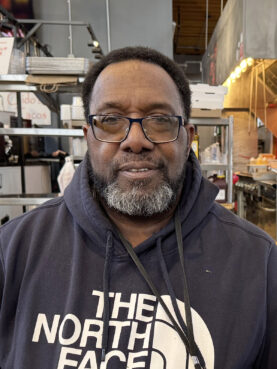
The Rev. Michael Young. (RNS photo/Kathryn Post)
A different Springfield group made up largely of Black churches, Interdenominational Ministerial Fellowship, has been attentive to the spiritual dimensions of what’s at stake with the looming TPS terminations. The Rev. Michael Young, who leads IMF, told RNS the organization has called for a week of fasting and praying starting on Jan. 28. He said he would be praying for the softening of the hard hearts of “people in this administration who profess to be Christians,” and for “divine intervention.” Banks, whose congregation is also participating in the fast, described it as a way to “remain in affiliation and intimate connection with those who are constantly experiencing precarity.”
Through G92, other churches are strategizing for ICE’s arrival. Central Christian Church, for example, is one of a handful of congregations gathering supplies in case Haitians need to seek sanctuary in their buildings. Immigration officers had long been restricted from arresting migrants in houses of worship until Trump rescinded those restrictions a year ago. Despite the change, Central Christian has received donated air mattresses, a refrigerator and a washing machine for migrants who might shelter there long-term.
“Our top priority is for taking care of our own families, so that if they feel threatened, they have a place to go,” said Ruby. “So I meet with them regularly and share that message. If you are scared, anything scares you, come to Central, and we will open the doors. You can come in, and we will stand between you and ICE.”
G92 has also offered rapid response trainings that focus on nonviolence and “love for your enemies.” At Saturday’s training, attendees learned calming techniques, how to spread word about ICE activity and what roles to take on the scene (action leader, medic, documenter, etc.). They also learned tactics for using whistles, treating tear gas and getting useful video documentation.
After a pizza lunch, attendees were given four different hypothetical scenarios to implement in their training. During the first roleplay, news broke of another ICE fatality in Minneapolis, with the fatal shooting of Alex Pretti, who was acting as an ICE observer. As attendees checked their phones, the update underscored the risks that could come with the work they were training for.
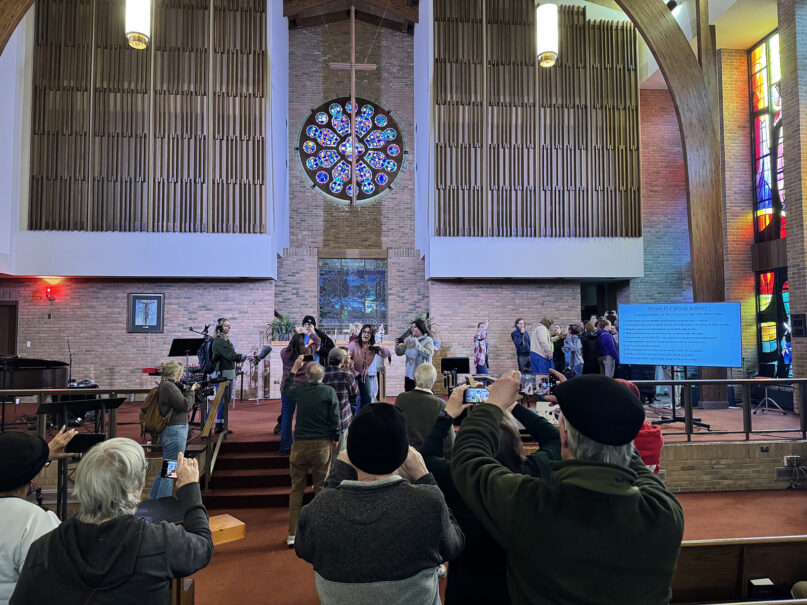
Attendees role-play scenarios of interacting with immigration agents during a rapid response training organized by G92 at Central Christian Church, Saturday, Jan. 24, 2026, in Springfield, Ohio. (RNS photo/Kathryn Post)
But for those who’ve been standing alongside the Haitian community since Trump’s comments in 2024, risks aren’t new. In 2024, neo-Nazi and white supremacist groups descended on Springfield, distributing racist flyers and staging protests in front of the mayor’s home. In February, the city of Springfield sued Blood Tribe, a neo-Nazi group whose leader, the suit says, took credit on social media for spreading the false claims about Haitians in Springfield. The lawsuit accuses the group of engaging in a campaign of hatred and intimidation that culminated in death threats, bomb threats and harassment.
Ruby has found accusatory signs posted on his church doors condemning his support of the Haitians — state homeland security has advised Ruby on how to take precautions for his safety. Rollins, one of the plaintiffs in the city’s lawsuit, told RNS that American culture has trivialized hate rhetoric “to the point where for many people, it’s almost like a spiritual charism.”
When reflecting on her work with Springfield’s Haitian community, Rollins, who is Catholic, acknowledged the weightiness.
“I am a very faithful person, but what I’ve found is that this has deeply challenged my faith daily,” she said. “Ironically, it’s been the immigrants that have continuously brought me back to my faith.”
