
(RNS) — Back in 2021, a group of evangelical families, including the founders of Hobby Lobby, began funding a new ad campaign, hoping to help skeptical Americans give Jesus a second look and to convince people to be a little kinder to one another.
The website for the campaign describes the mission this way: “Our hope was that more people could encounter love. More joy. More peace. A greater sense of purpose.”
Known as “He Gets Us,” the campaign, which launched in 2022, focused on the human side of the Christian Messiah, with billboards and black-and-white video ads showing people with loneliness, anxiety and other struggles, and ending with the claim that Jesus understood those struggles. Other ads showed Jesus as an immigrant or a rebel against the status quo, who loved those he disagreed with.
An ad for the 2023 Super Bowl, titled “Love Your Enemies,” featured images of Americans at each other’s throats and in each other’s faces, as English singer Rag’n’Bone Man’s hit song “Human” played.
“Jesus loved the people we hate,” the ad claimed.
For the 2024 Super Bowl, “He Gets Us” offered an ad with a series of foot-washing tableaus, each featuring an unexpected pairing: an older woman washing the feet of a young girl, a cowboy the feet of an Indian, a white Catholic priest the feet of a queer Black person.
Last year’s Super Bowl ad continued the “let’s all get along” theme, showing Americans from different walks of life helping each other, including a man in a John 3:16 hat embracing another man at a Pride march, with the tagline “Jesus showed us what greatness was.” That ad also featured Johnny Cash’s cover of “Personal Jesus.”
Yet four years — and more than $700 million – after the launch of the ad campaign, Americans remain just as polarized. Few seem to buy the idea that Jesus can bring the country together or feel a need to love their political enemies. And while the decline in religion in America has paused for now, that decline will likely be short-lived, according to long-term polling data.
That reality, along with pushback from evangelicals that the ad campaigns were too “woke,” has led the “He Gets Us” campaign, now run by a nonprofit called Come Near, to shift course.
In the last few months, and leading up to the 2026 Super Bowl, a new set of ads, known as “Loaded Words,” focuses less on social conflicts and more on the pressures and noise of modern life. One online ad, called “Don’t,” which has been viewed more than 68 million times, starts with a close-up on a newborn, with a mother’s voice saying, “Don’t be afraid.”
That’s followed by a host of other voices, giving warnings like “don’t mess up,” “don’t make a scene” and “don’t you dare let us down.”
“What if the only expectation was love,” the ad asks. “Jesus doesn’t expect us to earn it.”

Simon Armour. (Photo courtesy of Come Near)
Another ad, called “Do,” looks at the pressure to do it all — to be popular, to be beautiful, to be a team player, to be the best. Simon Armour, chief creative officer for Come Near, told RNS in an interview that the ads were developed using what he called a “neighbor-led” approach, built on research that asked Americans about their spiritual needs and life experience.
That research, said Armour, showed that Americans felt pressured to be busier, to acquire more stuff, to gain more recognition —so that life would then be meaningful.
“What we kept hearing was that was failing them — that their life is not turning out how they wanted,” he said. “They’re in this place where the noise is constant, with digital media, social media, our phones.”
Adweek, an industry publication, summed up the new take on “He Gets Us” this way: “In its fourth Super Bowl appearance, He Gets Us is getting personal.”
In the four years since “He Gets Us” launched its first campaign, the videos have been viewed nearly 10 billion times, while 70 million visitors have clicked on the HeGetsUs.com website, which has averaged about 700,000 visits a week since the “Loaded Words” campaign launched in December.
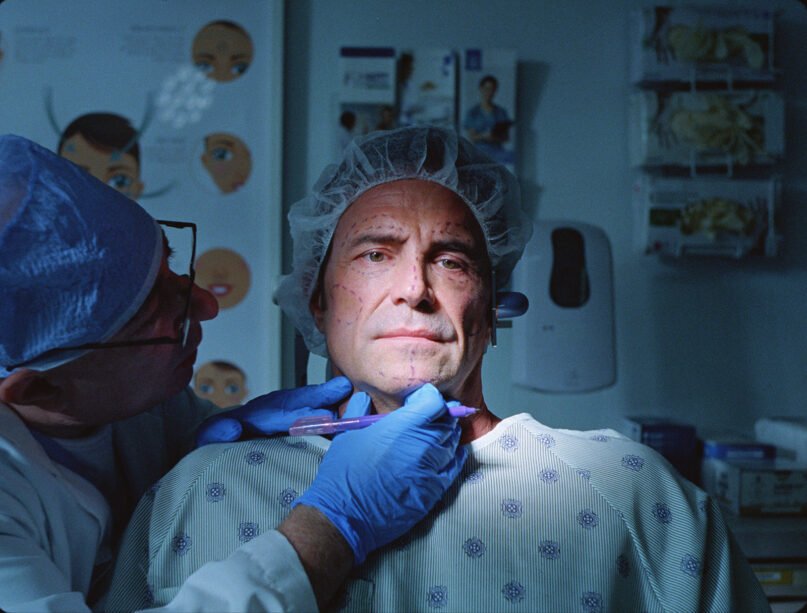
This year’s Super Bowl Ad, titled “More,” takes on the noise of modern life, with images of online influencers taking selfies and of a race car driving in circles and getting nowhere.
“The spot is really showing the thing we all feel, which is the absurdity of where things are at,” Armour said. “We’re chasing our tails, we’re going fast, but going nowhere.”
Armour hopes the new ads will connect with the spiritual needs of viewers.

A still from the new “He Gets Us” commercial. (Image courtesy of Come Near)
“It doesn’t matter who you are, where you’re from, where you’re at in a spiritual journey,” he said. “Jesus has something relevant for you. He gets you. He sees you. He knows you.”
For the campaign’s fourth Super Bowl, Armour said, the “He Gets Us” ads were due for a new direction. He said brands often evolve — otherwise, the message gets stale.
“After a period of time, people can see it coming,” he said. “It’s less surprising. It doesn’t cut through as much.”
The “He Gets Us” ad isn’t the only faith-based message that will air at the Super Bowl. The Blue Square Alliance Against Hate, a campaign to combat antisemitism and other forms of religious-based hatred, will also air an ad, called “Sticky Note,” during the NFL championship. That campaign was founded by Robert Kraft, owner of the New England Patriots. The Patriots will play the Seattle Seahawks for the Super Bowl title on Sunday (Feb. 8).
The “He Gets Us” ads have been controversial from the start, in part because the project was funded through The Signatry Foundation, a Christian donor-advised fund that has also donated to anti-abortion and anti-LGBT groups and had ties to conservative donors. Conservative critics, including the late Charlie Kirk, claimed the ads presented a distorted version of a Jesus who didn’t care about politics or who tolerated sinners, or that the ads were too weak and woke.
“The marketing group behind ‘He Gets Us’ has done one of the worst services to Christianity in the modern era,” Kirk said in 2023, after the foot-washing Super Bowl ad aired that year. “The Green family are decent wonderful people who have been taken for a ride by these woke tricksters. So sad!”
The ads have been costly.
According to disclosures filed with the IRS, the Signatry Foundation spent $429.8 million on “He Gets Us” from 2021 to 2024. Come Near, the nonprofit that took over the project in 2024, is organized as an association of churches and does not disclose its finances. However, the nonprofit projected it would spend $345 million on the campaign between July 2024 and June 2026, when it applied for tax-exempt status. A spokesperson for Come Near said those figures “represented a reasonable and good faith projection of future finances.”
Organizers told RNS in the past that the goal was spend a billion dollars on the campaign.
Nicole Martin, a member of the Come Near board of directors, said that “people have a lot of opinions” about the “He Gets Us” ads. She said the ads aren’t aimed at people who already believe in Jesus and go to church. Instead, she said, they are meant to speak to outsiders.
“This is for people who just need to believe in something — and Jesus is the way to reach them,” she told RNS in an interview. “That’s why I am involved.”

Nicole Martin. (Photo by Imiivo Studios)
Martin, who was recently named president and CEO of Christianity Today, a prominent evangelical publication, said the ad campaign has made Jesus part of the public conversation around the Super Bowl. That’s especially important in a time when religion in America has been on the decline, and many young people don’t know as much about Christianity.
“I think the goal is to try and shift that trend by a few degrees so that there would be a generation who wouldn’t grow up without knowing Jesus. That’s what I think they’re trying to do.”
She hopes the new ad will remind people there’s more to life than the noise of social media and online debates. And to take a break from the hectic pace of life.
“I’m hoping that this commercial will give us a chance to breathe,” she said.
(Editor’s note: This story has been updated with newer traffic data for the HeGetsUs.com website and more detail about Come Near’s tax-exempt status.)
