
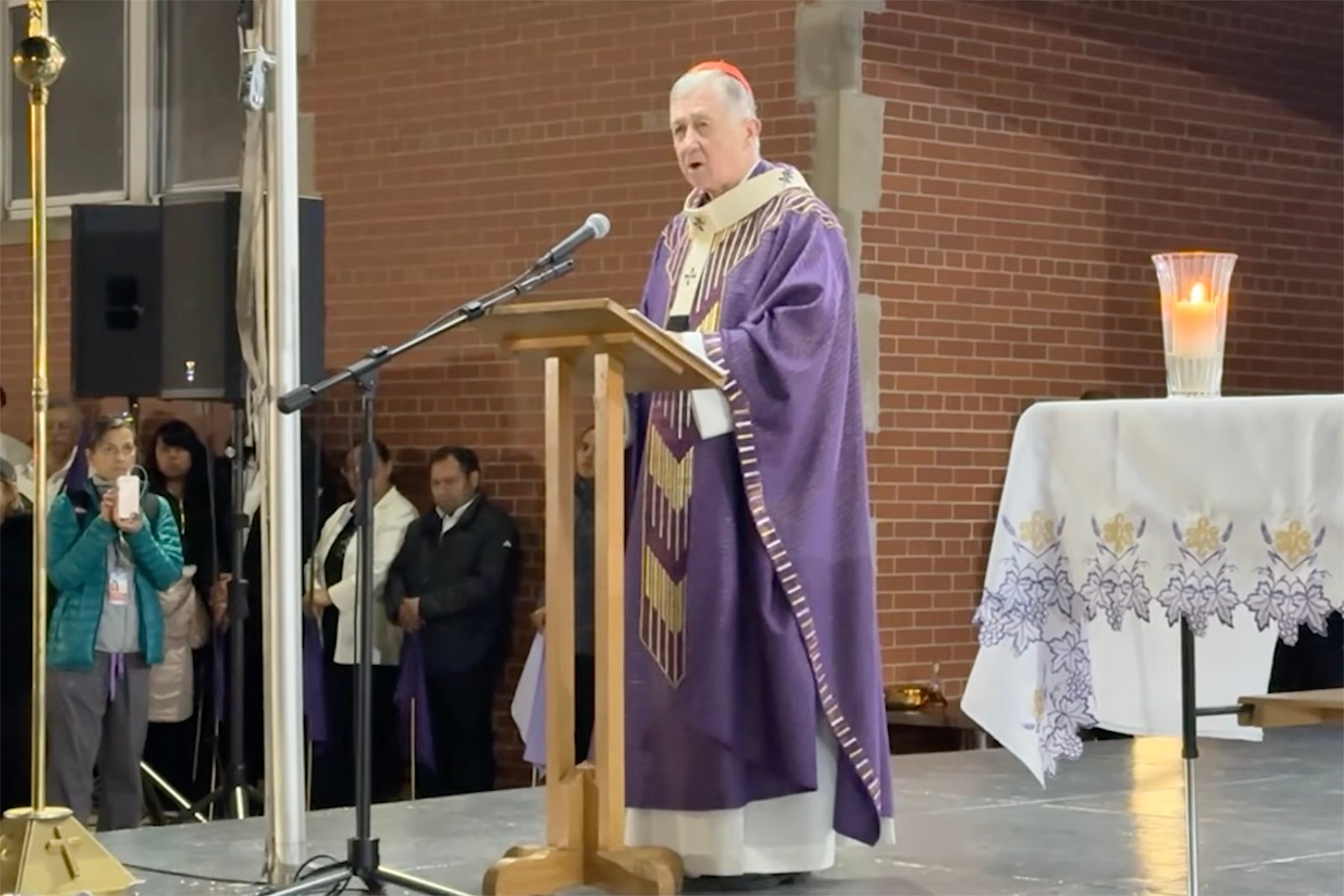
(RNS) — The Shrine of Our Lady of Mount Carmel is nestled among the well-kept homes of the working-class Chicago suburb of Melrose Park. On Ash Wednesday (Feb. 18), an altar had been erected under a tent outside the church surrounded by a thick crush of 2,000 people who prayed, sang and jostled our way through the ritual. (Fifteen hundred more were somewhat more comfortably inside the church.) When it came time to distribute first ashes, then the Eucharist, there were no neat lines, no aisles or pews — the church building housed only the overflow crowd who would have otherwise blocked the street.
But this was not chaos. Strangers united by faith and peaceful purpose were patient with one another, helped each other. We knew why we were there.
Illinois Sen. Dick Durbin and the local congressman, U.S. Rep. Chuy Garcia, prayed outside with us. They were not the most honored guests, however; nor was Cardinal Blase Cupich, the archbishop of Chicago, who had come to preside at the Mass. We were there to hold up the family members and other loved ones of residents of Chicago who have been detained, deported or disappeared by the Trump administration. The delegation represented all of those who have been tormented, taken and killed since last year. It was this group who came directly behind Cupich in the procession that began the Mass, the place normally reserved for the most senior cleric presiding at Mass.
That gesture identified these immigrant families and those they represented with the Jesus whose mission, death and resurrection we were there to commemorate.
The cardinal’s homily struck that same theme — uniting mistreated immigrants with God’s love. Cupich seized on the image of dust present in the reminder given on Ash Wednesday as the ashes are imposed on the foreheads of the faithful: “Remember you are dust, and to dust you will return.” Lamenting the suffering of “those who are made to feel like dust,” he observed that dust is found “in construction, in cleaning, in harvesting crops from the fields” — varieties of work that support many immigrant families.
He recalled that God “got down into the dust” when God created us. God “touched” the dust, “molded” it, breathed life into it to create each of us. “You may be undocumented in the eyes of the state,” he said, “but you were handcrafted by the creator of the universe. Your worth does not come from a visa or a permit; it comes from the breath of God inside you.”

The Mass at Our Lady of Carmel was the latest “mobilization” organized by the Coalition for Spiritual and Public Leadership — so-called, said CSPL board chair Anthony Williams before the Mass, because they are opportunities to resist the Trump administration’s immigration enforcement strategy in an unusual, prayerful, peaceful way. They are meant to remind believers that “Our faith calls us not only to pray but to act.”
Most of all, these mobilizations unite the church to the families and others affected most by the administration. The events allow them to see and feel the presence of the whole church gathered to support them — both the swollen crowd that spilled out into the neighborhood and in the person of Cardinal Cupich, known to be close to Pope Leo XIV, who grew up in another working-class Chicago suburb.
When the Mass ended, hundreds of us processed through the neighborhood, walking behind a banner saying, in English and Spanish, “God’s Love Knows No Borders.” We moved through the streets in silence, holding candles, pausing to recite a decade of the rosary at stops along the way. Sorrowfully, we remembered all of the suffering the Trump administration has created. Many, I expect, prayed that all of this would come to an end. For my own part, I thought of something we had heard in the Ash Wednesday Mass: “Rend your hearts, not your garments.”
Those words of the Hebrew Prophet Joel are among the first we hear in the Ash Wednesday liturgy. Joel wrote amid disaster, centuries before Christ came. A plague of locusts had devastated the land, and a feeling that God had abandoned them haunted the Kingdom of Judah. Yet Joel heralds God’s promise. God waits for them. All they must do is return to God sincerely. A conversion that is inward, not just some outward show, is all God desires. God will be there when we are ready to return.
What does it mean for a people to return to the better version of themselves? What is required? How do we do it?
Anything we do together as a people, we must do both cooperatively and also each alone. Our way has to be like the thick crowd at the Mass, forgoing disorder and chaos. Uncountable individual choices to be patient, to smile, to give way to someone else made that crowd a people united to become the best version of what human beings in action together can look like. We did it each ourselves, and we did it all together.
It has to be like that procession through the streets, a protest, yet no shouting, no destruction of property. There was no disorder, no matter how angry we all were about all that has happened. That Mass and procession showed that a different way is possible.
This way is not easy. It requires a deeply felt sense of shared purpose — even faith. It demands a real change of heart, each of us singly and all of us together as a people. It cannot be forced. To turn a people into a better direction requires something else. It must be given an opportunity. It must be prompted. It must be invited. But each person must decide for change before their choices begin to make change.
This is why CSPL’s mobilizations are so effective, and so promising. Pairing prayer with action brings the witness of faith to the public square attractively, and the experience of it invites each of us to reflect on how we’re engaging the challenges we face in this moment. Not inconsiderably, these mobilizations also pose a real alternative to the anger and violence we see almost everywhere else.
For Catholics, the church is “the mystical body of Christ,” a living presence of Jesus. As much as the Eucharist, Jesus is present in his people in the communion of the church. Our social action, for one another and for justice, as effectively expresses what we believe as prayer does. The more that mystical body moves and acts among the people, enlivened by prayer and united by purpose in peace, the more effectively we will call this people through conversion to return.
For one night it seemed more than possible that, gathered as that mystical body to surround the delegation of family members with our encouragement, support and presence, we can be a better people. We can be better even than what we were before.
(Steven P. Millies is the author of “Joseph Bernardin: Seeking Common Ground” and “A Consistent Ethic of Life: Navigating Catholic Engagement With U.S. Politics.” The views expressed in this commentary do not necessarily reflect those of Religion News Service.)
