
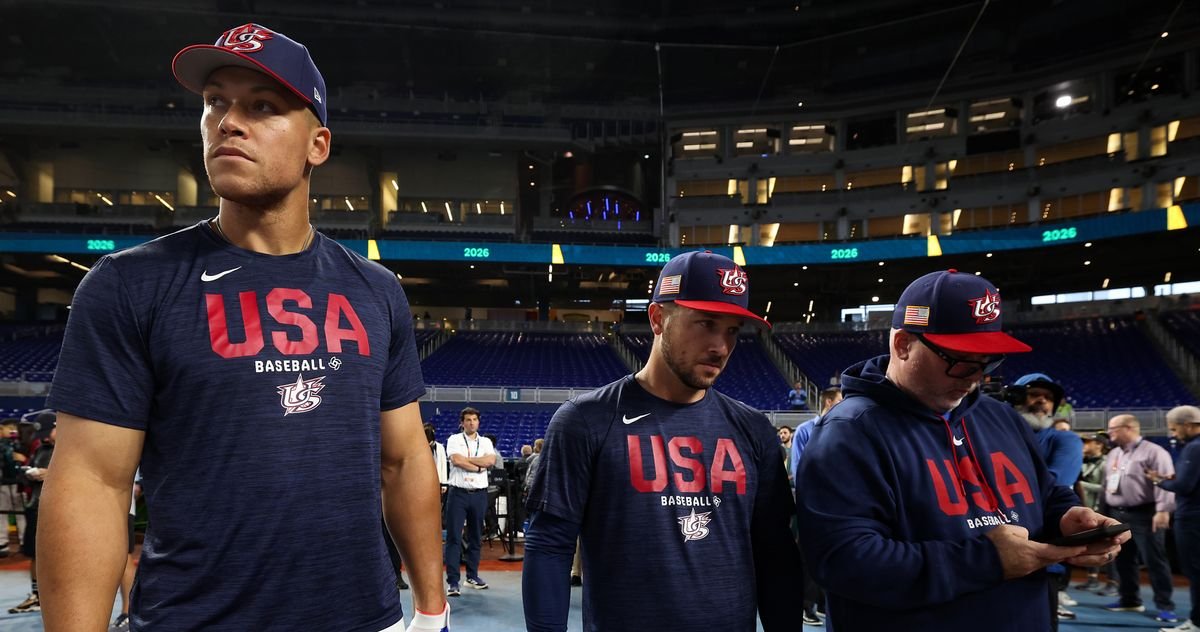

Before the 2026 World Baseball Classic game between the U.S. and Venezuela in Miami, Florida.
Photo: New York Yankees/Getty Images
On March 7, as the World Baseball Classic was starting to ramp up, Team Venezuela manager Omar López kicked off a press conference with a plea to reporters. “Please,” he said in Spanish, according to ESPN, “don’t ask me any more questions about the political situation of my country.” Venezuela had descended into chaos after U.S. troops snatched its president, Nicolás Maduro, from his home in January, leaving many of López’s players scrambling to get out. Some worried they wouldn’t be able to get visas for MLB spring training if they waited too long. Some feared that speaking out about politics would jeopardize the safety of their loved ones back home.
But López’s plea wasn’t just about self-preservation. Like many major international athletic events, the triennial WBC operates under the delusion that politics and sports can be kept separate. It has strict rules prohibiting political speech. López was militant about his team obeying them throughout its Cinderella run to the WBC final. And yet, by the time pitcher Daniel Palencia threw the final strike on Tuesday, capping off Venezuela’s stunning 3-2 upset victory over the U.S., it was clear that these rules were less about keeping the sport pure than distorting what qualifies as political behavior. And no one benefited from that more than Team USA.
This seemed at first to be a mere difference of affect: The Team USA roster was effectively a dream team of MLB superstars — reigning home-run leaders Cal Raleigh and Kyle Schwarber; the best hitter in the world in Aaron Judge; Cy Young–winning pitchers Paul Skenes and Tarik Skubal. Yet none of them seemed to be having any fun. They approached the event with a stoic, businesslike mien, what podcaster Jimmy O’Brien described as a “1950s, hard-nosed, football mentality.” Cal Raleigh refused to shake hands with his Seattle Mariners teammate, Randy Arozarena, because Arozarena was playing for Team Mexico and the U.S. had a policy of putting “country ahead of teammates and friendship.”
Meanwhile, back in the normal world, the teams from the Dominican Republic, Venezuela, and Italy were setting social media ablaze with their infectious exuberance. The Dominican locker room looked like a 24/7 dance party. After Venezuela’s Wilyer Abreu hit a go-ahead homer against Team Japan in the quarterfinal, he threw his bat so high in the air his teammates had to duck to avoid getting hit as they exploded out of the dugout to embrace him. Team Italy, which was composed largely of Italian American MLB players relishing the quirks of their old-world heritage, kept an espresso machine on hand to brew shots for whenever they scored. On the whole, the tournament came off as an emotional, at times raucous, celebration of the global reach of America’s pastime — for everyone except the American team.
It wasn’t just that the players were stoic and antisocial; Team USA appeared at times to go out of its way to broadcast disdain. After their penultimate game of pool play, the U.S. players stayed up late drinking despite having a game against Italy the next day. Manager Mark DeRosa told reporters ahead of the first pitch, “We want to win this game even though our ticket’s punched to the quarterfinals.” He went on to deploy a lineup of largely bench players, including the aging Paul Goldschmidt, that seemed to confirm the A-team was indeed “hurting” and that he didn’t think this game was that important. Team USA ended up losing to Italy 8-6 — and realized only then that their ticket to the quarterfinals had not, in fact, been “punched.” (Italy still had to beat Mexico in order for the U.S. to advance.) Apparently trying to get ahead of his team’s suddenly very possible early exit, USA first baseman Bryce Harper told reporters, “Obviously, the WBC is great, but it’s not the Olympics.” The U.S. managed to advance after all, but DeRosa had created such an embarrassing furor that the MLB scrubbed the video of his comments from its website.
At this point in the tournament, the U.S. team was merely embodying its country’s reputation as an arrogant and ignorant geopolitical villain — not actively embracing it. There was a queasy undercurrent of militarism from the jump; off the field, players wore T-shirts that read “Front Toward Enemy,” the phrase inscribed on Claymore mines used in combat. But it went into overdrive when DeRosa invited controversial ex-SEAL Team Six member Robert O’Neill to give the team a pep talk before its quarterfinal matchup against Canada. Photos shared on social media show O’Neill — who has built a personal brand claiming to have killed Osama bin Laden, to the chagrin of his fellow former SEALs — giving a lecture meant to remind the team “why,” in DeRosa’s words, “we wear ‘USA’ across our chest.” It was naked jingoism, essentially an advertisement for the U.S. military of the sort no other team felt compelled to broadcast.
The spectacle was especially in bad taste after the U.S.-Canada gold-medal men’s hockey game in the Milan Olympics became a crude partisan circus. After the U.S. won that match in February, the players celebrated in the locker room with the director of the FBI; the White House tweeted a photo of a bald eagle drowning a Canada goose; and Trump paraded the team onstage during his State of the Union address. But most of the bad blood between those two countries could be chalked up to the administration’s trollish but as of yet unrealized threats to make Canada the 51st state. In the WBC, after the U.S. defeated Canada and then the Dominican Republic in the semifinal, it moved on to the finals to face a country much more devastated by American geopolitical action: Venezuela. Here, the stakes were more fraught. After all, the U.S. had not spent months demagoguing Canadian immigrants as gang members, deporting them en masse to a Central American megaprison, or using special forces to kidnap Canada’s prime minister for arraignment on narcoterrorism charges while declaring ownership of the country’s most valuable natural resource.
A promotional walk-in video posted by the USA Baseball X account ahead of the final captured the team entering the stadium in slow motion, as stiff and stony-faced as ever, draped in game-worn USA Olympic hockey jerseys. Outside the locker room, LoanDepot Park in Miami was full of ecstatic Team Venezuela fans, a reflection of the city having the biggest Venezuelan immigrant population in the U.S. “We have lived through many difficult things inside our country,” one fan told Yahoo! Sports. “This is the moment for Venezuela to accomplish something so special and memorable.” The symbolism was inescapable. Even if O’Neill hadn’t shown up in the dugout during the tournament, few sporting events in recent memory would have been freighted with so much geopolitical subtext. President Trump clearly noticed. “Good things are happening to Venezuela lately!” he wrote on Truth Social after the team beat Italy in the semifinal, setting up the showdown against Team USA. “I wonder what this magic is all about?”
Because Americans are notorious for cynically demanding that athletes keep quiet about politics, it was revealing to watch the U.S. team emerge as the most eager to smuggle a version of its current politics into the tournament. The American right has long used this standard as a cudgel to stop players from protesting inequality. “Shut up and dribble,” in the words of Fox News host Laura Ingraham, was elevated to a cultlike mantra at the height of the Black Lives Matter movement. But the effect was never to preserve the apoliticism of sport. It was to ensure the right kind of politics dominated it. When it came to the WBC, the rules against political expression merely ensured that Team USA could act as a proxy for its government’s propaganda while the rest had to keep quiet. The catharsis of Venezuela’s victory, while that nation faces an American-made crisis, shined through anyway. “This is a celebration,” said Venezuela third baseman Eugenio Suárez after the game, “for all of the Venezuelan country.”
