
January 12, 2026

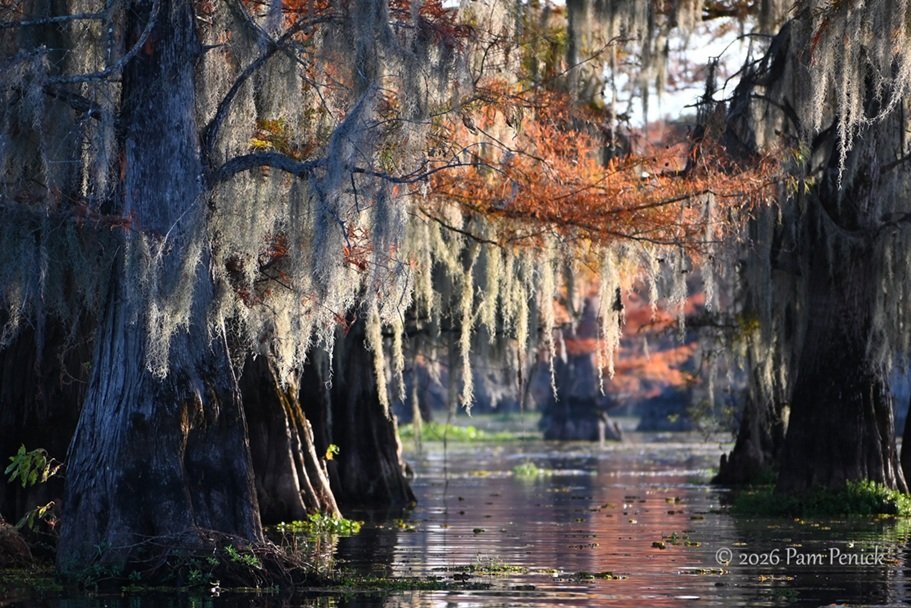
In the middle of my book tour last November, my husband and I squeezed in a long-planned trip to Caddo Lake. For years I’d been keen to see Caddo in autumn, when its swampy forest of bald cypress turns burnt orange, glowing above hoary tendrils of Spanish moss and flared trunks rooted in black water. After watching M. Night Shyamalan’s 2024 thriller Caddo Lake — a sign, it seemed — I decided it was time to see the mazey, gothic beauty of the place for myself.

It took some planning. A 5-hour drive from Austin, Caddo Lake winds across the state line between northeast Texas and Louisiana. Lodging is mainly cabin or guest house rentals in the hamlets of Uncertain (population 85) or Karnack. I nailed down a cabin in Uncertain in early January via a phone call with the genial owner.

To photograph scenic areas of the lake, I needed a guide with a boat. With the cabin secured, I let it slide for a couple of months, and that was almost a mistake. Turns out, I wasn’t the only photographer planning a fall visit and wanting a boat tour at the golden hours of sunrise and sunset. By the time I started calling around, in early May, I was getting “sorry, I’m booked up” replies.

Before panic set in, I found a spot with Paul Keith, a Caddo Lake photographer and fishing guide with a Skeeter bass boat. He gave us a memorable 2-hour sunset tour, followed by a sunrise tour the next day. This post features photos I took during the sunset tour. In part 2, I’ll share sunrise tour photos.
Birdwatching

Photographing wildlife is one of my great joys. I hoped for, but wasn’t lucky enough, to see an alligator at Caddo. However, we saw a number of birds including great egrets (above), osprey, pileated woodpeckers, herons, American coots, cormorants, and northern flicker.
Dick & Charlie’s Tea Room

We cruised past the famous Dick & Charlie’s Tea Room, a shack on stilts half hidden by ghostly cypresses. I’d seen it in many photos from Caddo.

A hand-painted sign lists the house rules: 1. There ain’t none. 2. There never was none. 3. There ain’t gonna be none.
Sunset tour on Caddo

Paul zipped the boat along tree-lined lanes of water, heading for a more open section of the lake where we’d have a good sunset view.

He stopped at picturesque cut-throughs like this, where the afternoon light set Spanish moss and cypress leaves aglow.

The Spanish moss hangs like ZZ Top beards, or silver Mardi Gras beads after a parade.

It’s fascinating to see trees happily growing in water. Caddo is said to contain the largest bald cypress forest in the world.

Bald cypress seeds need dry land to germinate, and seedlings can’t survive complete submersion for long. Periods of drought, when the water level drops, gives seedlings time to establish. Although the lake formed naturally, it’s been dammed since 1914. That’s had a negative impact on bald cypress seedlings. “Due to the relatively constant water-levels resulting from dams on Caddo Lake and Lake O’ the Pines (as well as beaver and nutria damage), few seedlings have survived at Caddo Lake in the last 100 years,” says the Caddo Lake Institute.

A 2019 article in Texas Highways adds, “Though travel brochures boast of ‘400-year-old bald cypress trees,’ in fact almost every tree you see in the lake dates from the early 20th century.”

Cormorants roosting in bald cypresses

Great egret


As the sun sank, the cypress trees glowed a deeper orange.

There were tinges of gold too.

The trunks were equally beautiful.

Roosting time was nigh for the lake’s birds.

Paul slowed to a crawl, and we puttered among the orange trees.


I saw a few duck-hunting blinds on the lake, including this thatched hideaway.

American coots looking for safety in numbers


Some bald cypresses develop buttressing roots or knees, but I’d never seen any like these.

At sundown, the trees became bottle-shaped silhouettes against a melon-colored sky.


And there it goes.

Rose-and-lavender clouds echoed in the water as we headed back to Uncertain.


A war against invasive plants at Caddo Lake

I saved this for the end because I wanted you to see the extraordinary beauty of Caddo first. As we motored on the lake that afternoon, I was enchanted by lavender flowers held above glossy leaves — until Paul informed me it’s an invasive aquatic plant called water hyacinth.

Since being introduced to Caddo, water hyacinth outcompetes native aquatic plants and chokes out habitat for wildlife.

It’s beauty and the beast, all in one.

But water hyacinth isn’t even the worst invasive plant in Caddo Lake.

Giant salvinia is. Native to Brazil and first found in Caddo in 2006, giant salvinia expands exponentially in calm, shallow water. Every week — bam! — it doubles in surface area. It’s a lake-eating monster.
As salvinia spreads, the water “disappears,” hidden beneath what looks like verdant solid ground. But salvinia smothers native aquatic life. It also makes boating difficult, threatening recreation and tourism.

It’s a dire problem for those who love and depend on Caddo Lake for their livelihoods. Many inventive ways of beating back salvinia have been tried, including the introduction of a natural predator, a Brazilian weevil that feeds on the plant (watch this fascinating 3:43-minute video). But success has been limited. The weevil, for example, doesn’t always survive a Texas winter, while the plant itself is more cold tolerant.
During my stay at Caddo, I learned that the Texas Parks & Wildlife Department (TPWD) has been regularly spraying herbicides on the salvinia since 2015. TPWD has written about this approach in its own magazine. In a December 2025 article, the agency acknowledges tradeoffs:
“While herbicide may be an imperfect solution (it does cause some damage to other aquatic plants), it is necessary to keep the giant salvinia at bay. ‘This is our best option at this present time, because if you do nothing, that lake will be covered up in a matter of months,’ says Laura-Ashley Overdyke, executive director of the Caddo Lake Institute, in an interview with NBC. ‘Back in 2013, half of the lake was covered. You could crash that lake out, and have everything underneath the water die.’ Overdyke likens the use of herbicides to treat salvinia to treating cancer with chemotherapy. ‘The salvinia is the cancer, the herbicide is the chemotherapy,’ she says. ‘It may have some downsides to it, but without it, we don’t have a lot of tools in our toolkit.’
“Keeping Caddo Lake’s Invasive Giant Salvinia at Bay,” tpwmagazine.com, December 2025
For another perspective, a July 2025 video on TikTok shows Caddo Lake guide Danny Sullivan describing what he says he’s witnessed: contractors on airboats spraying Roundup and Diquat from hoses “5 days a week…all through the year.” In this video and in other news interviews, he expresses concern about the impact on trees, wildlife, and people.
There’s also an Instagram account called killing_caddo_lake with multiple videos of guys on boats spraying plumes of liquid across the water. Protective gear appears minimal. Here’s one example, and here’s another. Other videos document dead snapping turtles found where spraying occurred.
Learning about the scale and duration of herbicide use at Caddo changed how I felt about being on the lake — about dipping my fingers in the water, drinking local tap water, even breathing the air. I understand it’s being done to save the lake. I understand if the spraying stops, salvinia will likely take over and kill the lake in its own way. It’s a terrible predicament.
But people who live, work, and recreate at Caddo deserve more information. What are the long-term risks to human health and the environment from repeated herbicide use at this scale? And if eradication of salvinia isn’t possible, is the spraying expected to continue indefinitely? At the very least, locals should have a meaningful voice in decisions that affect their lake and their lives.
Up next: Part 2 of my visit to Caddo Lake, on a sunrise boat tour with an osprey sighting.
I welcome your comments. Please scroll to the end of this post to leave one. If you’re reading in an email, click here to visit Digging and find the comment box at the end of each post. And hey, did someone forward this email to you, and you want to subscribe? Click here to get Digging delivered directly to your inbox!
__________________________
Digging Deeper
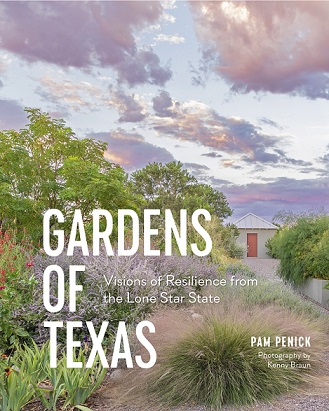
My new book, Gardens of Texas: Visions of Resilience from the Lone Star State, is here! Find it on Amazon, other online book sellers, and in stores everywhere. It’s for anyone who loves gardens or the natural beauty of Texas. More info here.
Come see me on tour! I’ll be speaking and hosting book events across Texas this spring to celebrate the release of Gardens of Texas. Join me to learn, get inspired, and say hello!
Learn about garden design and ecology at Garden Spark! I organize in-person talks by designers, landscape architects, authors, and gardeners a few times a year in Austin. Subscribe to Garden Spark by clicking here to email — subject line: SUBSCRIBE.
All material © 2026 by Pam Penick for Digging. Unauthorized reproduction prohibited.
