
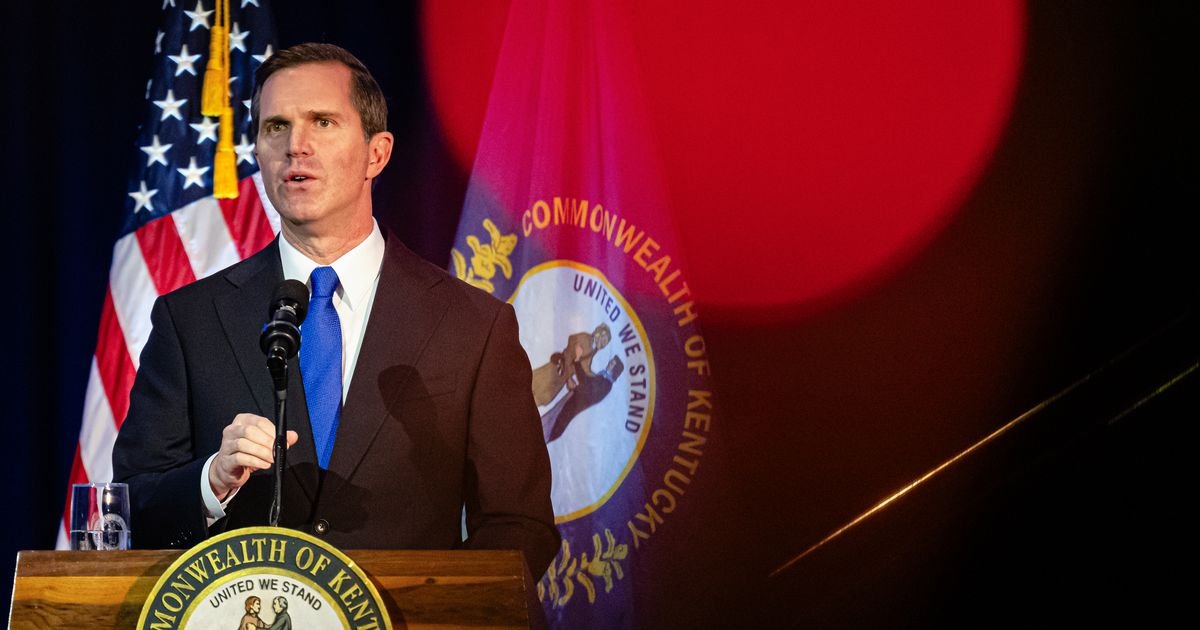

The very electable Andy Beshear.
Photo: Jon Cherry/Bloomberg/Getty Images
In a long profile of potential presidential candidate Andy Beshear at Politico, Jonathan Martin elicited one absolutely firm comment from the Kentucky governor about 2028: “The Democratic Party needs to nominate a Democratic governor.” He wasn’t just talking about himself, though he’s nearing the end of two terms as chief executive of a very red state. California’s Gavin Newsom and Illinois’ J.B. Pritzker are likely 2028 candidates perceived as very different in temperament and even ideology from the model moderate Beshear. Pennsylvania’s Josh Shapiro is perceived as being in the same “lane” as the Kentuckian, but doesn’t have the same laid-back personality. Maryland’s Wes Moore is an up-and-comer who hasn’t chosen sides in national party factional battles. Michigan’s Gretchen Whitmer’s star has faded a bit, but she’s still a major party figure who could take the presidential plunge.
Putting aside all these individuals and their specific strengths and weaknesses, is Beshear right about governors being not just a better bet for Democrats right now but essential for victory?
Traditionally, big-state governorships were thought of as the best platform for a presidential candidacy. Though only 17 of the 47 presidents were governors, only four men (James Garfield, Warren Harding, John F. Kennedy and Barack Obama) have gone directly from Congress to the White House. Among Democrats, however, the last sitting or former governor to win a presidential nomination was Bill Clinton. Indeed, the last governor to run a viable Democratic nomination contest was Howard Dean in 2004, and his signature issue was foreign policy (his opposition to the Iraq War). In the crowded 2020 Democratic presidential field, four governors or former governors ran, but three dropped out before Iowa and the other (Deval Patrick) had zero impact on the race. So the prospective bumper crop of Democratic governors in 2028 is rather remarkable.
What governors have that senators simply don’t is a record of executive accomplishment and practical management experience. Only the top tier of members of Congress get anything like the media coverage virtually every governor commands. As state civic leaders, governors are presumed to represent people of both parties even if they are the bitterest of partisans. And in this era of chronic anti-Washington sentiment, governors can treat the federal government with the disdain most voters feel.
A governor might also provide a positive contrast to the very likely GOP presidential nominee in 2028, J.D. Vance, who has never run much of anything other than his mouth. When he heads out on the 2028 campaign trail right after the midterms, Vance will have had two years experience as Donald Trump’s very subordinate attack dog, and two years as an obscure Senate backbencher who barely got his seat warm. And most of all, Vance will be the candidate of the incumbent presidential party in 2028, with any “outsider” claims looking ludicrous.
Looking at Trump-era Democratic politics more generally, senators make noise while governors at least have a chance to make laws, build things, and do things. This is one reason members of Congress posture so much about “fighting” Trump. Words are all they have. And in 2028, as Beshear makes clear to Martin, Democrats will likely be in a mood to stop fighting and start winning. All other things being equal, governors have an advantage in electability, if only because their identities transcend party and many of them have a record of winning Republican votes. If Democrats enter the 2028 election cycle feeling very confident of victory, maybe an AOC, who has never run a campaign outside New York City, or a Pete Buttigieg, whose top elected post was in a small Indiana city, will suffice. But if, as is more likely, prospects for victory look iffy, Democrats are very likely to look for a champion who’s not mostly known for long speeches in Congress (sorry, Cory Booker!)
Among the governors who may run in 2028, of course, Beshear is distinctive for his enormous political success in a state where Republicans have super-majorities in both legislative chambers and hold seven of eight spots in the congressional delegation. He would enter the nomination contest as presumptively electable. If he can just figure out how to excite people who have been “fighting Trump” so long that they sometimes mistake words for action and moral victories for actual victories, Beshear could go all the way to the White House.
