
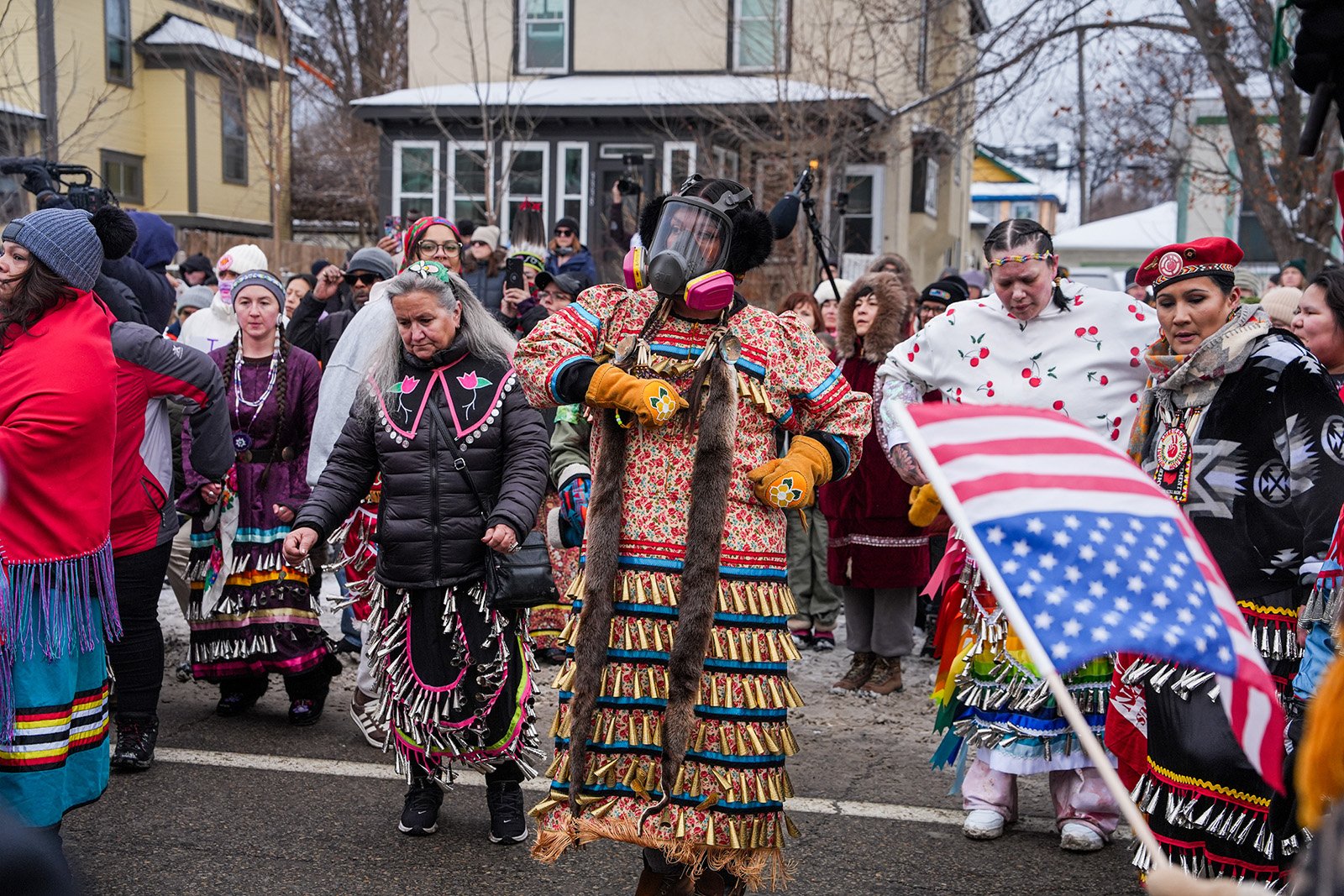
(RNS) — On Sunday (Feb. 1), a group of dancers in dresses affixed with metal noisemakers performed an Ojibwe traditional healing dance known as the jingle dress dance to the heartbeat of a leather drum in downtown Minneapolis. The swishing of the dancers’ dresses sounded like light rain as more than 100 Minneapolis community members followed them to the sites where two local residents, Alex Pretti and Renee Good, were killed by federal agents in recent weeks.
At each site, the group prayed, sang and danced in a ritual meant to promote healing and solidarity.
Nicole Matthews, executive director of the Minnesota Indian Women’s Sexual Assault Coalition, who helped organize the dance, compared the ceremony to a “medicine dance.”
“It was a community collaboration of Native women working together,” said Matthews. “We were there as a community to come together and bring healing to that place where, you know, significant trauma occurred.”
In Minneapolis many Native people say they are reluctant to leave their homes for fear of being detained by federal ICE agents. “We are seeing people being profiled based on the color of their skin,” Matthews said. “We have families who are afraid to leave their homes or send their kids to school.”
On Jan. 9, the Oglala Sioux Tribe reported that four unhoused tribal citizens were arrested by ICE during enforcement operations in Minneapolis. Tribal leaders say three remain in custody at a facility in St. Paul near Fort Snelling, a U.S. Army outpost during the U.S.-Dakota War of 1862. Locals connect the site with the imprisonment of Dakota Sioux people, culminating in the execution of 38 Dakota men in what is widely regarded as the largest mass execution in U.S. history.
Some people in the Native community have begun wearing their tribal identification on lanyards around their necks so they can show that they are tribal citizens and not immigrants. But Native leaders say that another way to mourn the violence in Minnesota, and resist fear and promote healing, is through traditional ceremony, prayer and worship.
“I think our prayer and our ceremonies and those cultural pieces that connect us are our strengths,” Matthews said. “The people that I talked to were very grateful for having that.”
Although Native people make up a small share of Minneapolis’ population — roughly 1% of residents identify as American Indian or Alaska Native, according to U.S. Census data — the Twin Cities area is home to one of the largest urban Indigenous populations in the Midwest. In Minnesota, there are seven reservations belonging to the Anishinaabe, another name for Ojibwe, and four Dakota communities, each with their own distinct culture and ritual.
Robert Two Bulls, an Oglala Lakota visual artist and pastor of All Saints Episcopal Indian Mission Church in Minneapolis, said his congregation of about 75 people, most of them Native, has seen attendance decline at Sunday services in recent weeks.

The Rev. Robert Two Bulls. (Photo courtesy of All Saints Episcopal Indian Mission Church)
“There’s a few showing up. A lot of people just don’t go out,” Two Bulls said, noting that frigid weather may have combined with ICE’s presence to inhibit attendance. All Saints is an “inculturated” church, meaning the Christian liturgy is grounded in Native culture. Congregants pray seated in a circle, while many hymns and prayers are recited in Anishinaabe, Dakota and English.
In this time of uncertainty, Two Bulls said much of the support he is providing his community is through listening. “I’ve noticed that people just want to talk,” said Two Bulls. “Some of them feel isolated.”
At All Saints, a monthly food pantry known as First Nations Kitchen serves Indigenous and organic cuisine to anyone who shows up. The 17-year-old program serves neighbors of many backgrounds — “Somali, Latino, white, Black, Native, a real working class neighborhood,” Two Bulls said. After moving the pantry outdoors during the COVID-19 pandemic, the church has recently moved food distribution indoors to reduce visibility after seeing federal agents driving by.
“ICE is made up of individuals from different parts of the country, so they have no idea what Native people look like,” said the pastor.
“We still have trained observers outside, and we bring all our guests inside. Our main concern is keeping people safe.” The church has also developed a protocol in case federal agents arrive during distributions, Two Bulls added.
But Two Bulls said the community hasn’t been deterred from providing services. “We continue on. We don’t let this fear override what we do,” Two Bulls said. “We still serve food. We still practice food justice. We still worship every Sunday. We just keep marching on.”
Robert Haarman, director of the Office of Indian Ministry of the Archdiocese of St. Paul and Minneapolis and community minister at Gichitwaa Kateri Catholic Church in Minneapolis, said his ministry’s small food pantry has been delivering meals and traditional medicines, such as sage, to homes.
“There are requests for some food,” said Haarman, who is not a Native person. “We have a small food shelf here that we can help with, and then we can also offer, like, some of the medicines that are used for prayer.”

Indigenous people perform during a memorial honoring Alex Pretti and Renee Nicole Good, who were both recently fatally shot by federal agents, on Sunday, Feb. 1, 2026, in Minneapolis. (AP Photo/Ryan Murphy)
The Rev. Joann Conroy, senior pastor of All Nations Indian Church in Minneapolis and an Oglala Sioux tribal member, said recent weeks have been difficult for her 20-person congregation. “People are stressed,” Conroy said. “People are afraid.”
Most, Conroy said, need a listening ear. “You see people come in, and they just need to tell somebody about their emotions and their fears,” she said. “They need to be heard.”
All Nations worships liturgy in the languages and traditions of its congregation, which Conroy said includes Ho-Chunk, Anishinaabe and Dakota, along with English. “We try to use the traditions of burning sage and different things like that,” Conroy said. There is a sacred fire pit outside of the worship area that is lit whenever worship is happening. “So people can go out and stand by the fire and pray,” Conroy said.
For Native community members in particular, Conroy said cultural tradition assists in healing and gathering strength, like burning of sage, sweetgrass, cedar and offering tobacco. “I think when people are seeking out spiritual help, just the seeking itself helps them cope,” she said. “Those practices help you be who you are. When those things are present and you smell those scents, it gives you strength.” All Nations has participated in protests in the city.

The Rev. Joann Conroy. (Photo courtesy of All Nations Indian Church)
Other Native leaders are taking a more confrontational approach. On Saturday, Feb. 7, Conroy’s daughter and co-pastor, Dr. Kelly Sherman-Conroy, helped organize a demonstration planned at the Whipple Federal Building, near Fort Snelling, which houses ICE’s local offices. Organizers have described the action as a symbolic “eviction notice” directed at the federal government, meant to draw attention to their demand that the United States dispossess Native American land.
The demonstration is expected to bring together Native clergy and community members from multiple faith traditions. The action will be followed by a memorial and grief ceremony at Powderhorn Park, organized by NDN Collective, honoring Renée Good and Alex Pretti and their families.
Jim Bear Jacobs, a Mohican pastor and racial justice leader, said he will be at the federal building tomorrow, “because this is my city, and this is my home, and the families that are being torn apart are my neighbors, and, in Indigenous understanding of the word, they are my relatives.”

Sharyl WhiteHawk poses at a memorial honoring Alex Pretti and Renee Nicole Good on Sunday, Feb. 1, 2026, in Minneapolis. (Photo courtesy of WhiteHawk)
Sharyl WhiteHawk, an Ojibwe activist and jingle dress dancer whose daughter helped organize Sunday’s ceremony, said Saturday’s gathering will include Arvol Looking Horse, the Lakota spiritual leader who carries the White Buffalo Calf Pipe, traveling from South Dakota to take part.
She described the response as decentralized and community-driven, with ceremonies and gatherings emerging organically. “People bring in speakers or plan gatherings. There’s no one person in charge. People are responding to what’s needed,” she said.
WhiteHawk said she expects Native communities to continue showing up for ceremonies, dances and memorials as long as federal enforcement remains present in Minneapolis.
“I think this is a lasting thing,” she said. “People will continue to do it, to keep bringing the medicine.”
