
February 28, 2026

Last week in Houston, I visited my alma mater for a meet-the-author event. The next morning, I returned to the Rice University campus for a leisurely exploration with my sister (also a Rice Owl) to see what’s new.

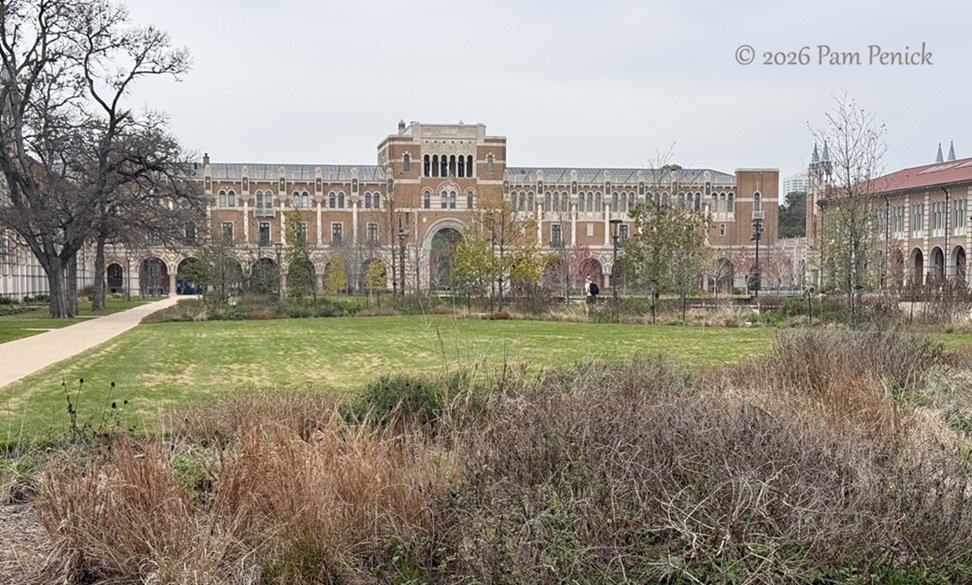
The landscaping of the Academic Quad has been transformed since my years at Rice. Today, beds of (largely) native plants follow arcing paths between the library and the Sallyport. Banished are the rigid geometry of lawn, boxwood hedges, and spindly Italian cypresses that once defined the quad.

The gardens were still in the semi-dormancy of winter, not yet cut back for spring, which let me see how much they’ve filled in since the quad reopened in autumn of 2024.

I’ve always loved the long views framed by Rice’s arched architecture — now with more plants.

While many of the new plants are native to southeast Texas, there are reliable nonnatives too, like giant ligularia. This patch grows beneath a large tree preserved during the redesign.

Sadly, that tree is ailing. I wonder if its root zone was damaged during construction. This shady corner may soon be sunny.

For now, the tree’s spreading limbs frame a view of a new gathering space outside the library.

Pergolas with red shade fabric filter the Texas sun, sheltering long tables — a great spot to study, people-watch, or hang out with friends.

A hangout for campus squirrels too

Before the redesign, there were zero inviting places to sit in the quad. That’s all changed.

Young loblolly pines will eventually shade tables on the library patio.

Nice view

Here’s the view from the center of the quad, looking back at Fondren Library. Monterrey oaks behind the benches will one day provide shade.

This granite plinth used to elevate the founder statue in the center of the quad. It’s now a platform for student speeches or performances — a reimagining centered on student activities.

A quote by JFK, from a 1962 speech at Rice, is carved into the base: “We meet at a college noted for knowledge, in a city noted for progress, in a state noted for strength, and we stand in need of all three.”

A sign of spring

An alum showing his family around asked me to take their photo here, and we got him to take ours too. Sister Owls!

A girl in her quinceanera gown was having her portrait made in one of the arcades, her dress as ornate as the architecture.

Today Willy’s statue resides in a corner of the quad. Who was Willy? A wealthy businessman in the late 1800s, William Marsh Rice planned to establish an institute “for the Advancement of Literature, Science and Art” in the city where he made his fortune. But in 1900, he was murdered by his butler — yes, the butler did it — and the money was nearly stolen through a forged will. The conspirators were soon found out, the money restored, and Rice opened its doors 12 years later.

The university’s Neo-Byzantine architecture, with its long brick arcades, is strikingly beautiful.

There are Space Age elements too, like this flying saucer of a bench wrapped around a tree.

Who can resist being the “I” in Rice? Not me.

A hoary live oak limb rests on a railing of the Chem Lec stairs.

At the George R. Brown Hall, a large arch frames a John Henry sculpture called Archer.

Looking the other direction, Archer echoes the color and geometry of the facade of Brockman Hall for Physics.

Rice’s crest rendered in tile

Brockman Hall floats above a rectangular pool filled with river rock. Chairs invite you to sit and enjoy the shade and the water. Shade is a theme of the architecture, as you might have noticed. In Texas, it has to be.

More arches, brick, and live oaks

At another building, green picnic tables zigzag along an arcade under moon-like globe lights.

Another arcade encloses Ray Courtyard, just outside the Ley Student Center

Here you’ll find the nondenominational Rice Chapel, a beautiful space with a curved wall of gold tile and stained glass windows.

Campuses make such pleasant walks, especially when the architecture is good. I highly recommend a walk around the Rice campus for anyone visiting Houston.
To read my previous posts about Rice:
Heading to San Antonio
A quick note to say I’ll be speaking today at San Antonio Botanical Garden. If you’re in the area, come join me.
February 28, 1-3 pm – San Antonio Botanical Garden
Join me for a “Gardens of Texas” presentation and discover practical strategies and inspiration for creating gardens with the resilience to weather Texas’s extreme climate. I’ll have books available for sale and signing too. This event is free with admission or Garden membership! Reserve your spot here.
I welcome your comments. Please scroll to the end of this post to leave one. If you’re reading in an email, click here to visit Digging and find the comment box at the end of each post. And hey, did someone forward this email to you, and you want to subscribe? Click here to get Digging delivered directly to your inbox!
__________________________
Digging Deeper
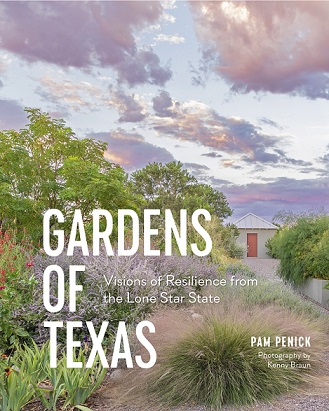
My new book, Gardens of Texas: Visions of Resilience from the Lone Star State, is here! Find it on Amazon, other online book sellers, and in stores everywhere. It’s for anyone who loves gardens or the natural beauty of Texas. More info here.
Come see me on tour! I’ll be speaking and hosting book events across Texas this spring to celebrate the release of Gardens of Texas. Join me to learn, get inspired, and say hello!
Learn about garden design and ecology at Garden Spark! I organize in-person talks by designers, landscape architects, authors, and gardeners a few times a year in Austin. Subscribe to Garden Spark by clicking here to email — subject line: SUBSCRIBE.
All material © 2026 by Pam Penick for Digging. Unauthorized reproduction prohibited.
