
May 24, 2026

“Not Arizona.” That’s the tongue-in-cheek name of a Centennial, Colorado, garden on last week’s Open Days tour. There’s not a thing wrong with Arizona, of course. But the name was born when a concerned neighbor tutted, “You know, this isn’t Arizona,” as John Murgel ripped out his thirsty lawn to make a waterwise garden.

The neighbor might have had a little faith. After all, John is a horticulturist who’s worked at Denver Botanic Garden and the Denver Zoo. He’s currently a faculty member at Colorado State University (CSU) Extension. All of which is to say, he knows the climate and he knows his plants.

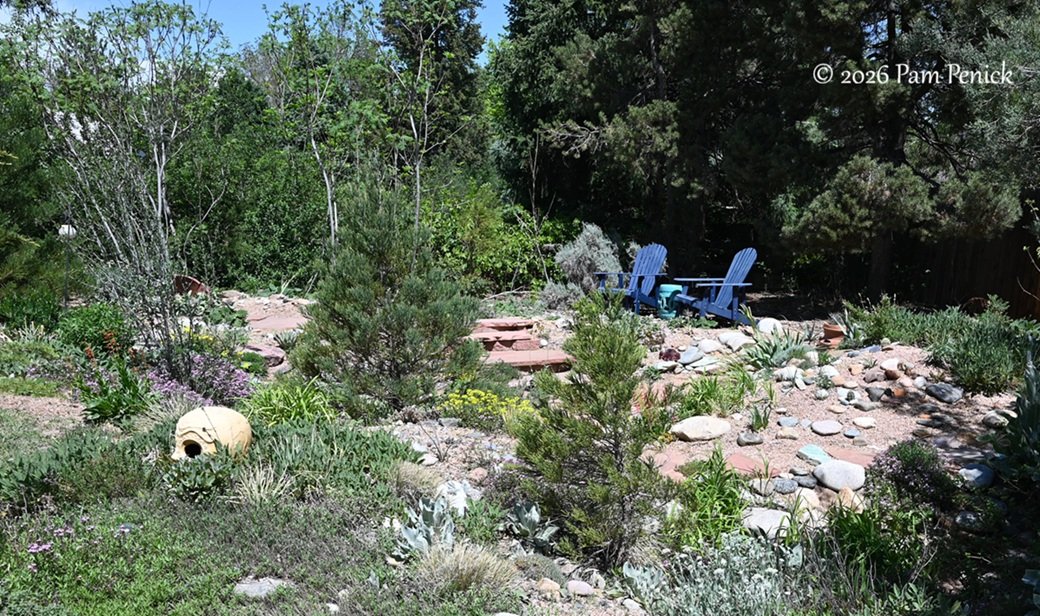
It was midday and very bright — challenging for photography — so I started my tour in the shadier back yard, where I admired a gravel garden with dips and mounds. John explained this used to be a koi pond, inherited with the house.

He re-homed the fish, drained the pond, and turned it into a sunny rock garden framed by a belt of trees along the fence.

From the shade, you can look out on the garden. A metal fish nods to what used to be.

A limbed-up stand of staghorn sumacs (Rhus typhina) caught my eye beyond the red sandstone path. John told me he had mixed feelings about them. He chose the sumac for its bright red fall color and ornamental fruits. Unfortunately, his sumacs — purchased as bare-root whips for economy — turned out to be male, which means they don’t produce berries. Their fall color is disappointing too — “green-brown to dirty yellow,” he said with a laugh. The plants also sucker, necessitating regular yanking up of shoots. Still, there are positives. John appreciates the trees’ structure, plus “they make good hummingbird perches.”

I paid special attention to the lower-growing plants, thinking ahead to my future downsized garden. Here’s Acantholimon and a blue-green yucca similar to one of my old favorites, paleleaf yucca.

A little agave — not sure which type

John’s path work is fun here, with a swirly fish paver and pink paver strips in a ripple-like pattern. Pink evening primrose color-coordinates.

A silver cow skull adds a little bling and desert style.

Greater sea kale has surprisingly large leaves for a dry-adapted plant.

View from the patio

Armenian basketflower, I think

In the front yard, John transformed his traditional, water-hogging lawn into a largely unirrigated garden of flowering perennials and grasses, including…

…fleabane…

…prickly thrift (Acantholimon)…

…penstemon (I think?), nearly in bloom…

…and king’s spear (Asphodeline lutea).

John’s yard is a corner lot, where a stop sign brings cars to a halt along his property. To screen traffic, he built up the corner garden with a truckload of gravelly soil and planted waterwise shrubs and small trees, with spreading perennials and cactus on the house side.

John said he hasn’t watered this part of his garden in 9 years!

Sea kale is one of my new faves for a dry garden thanks to ruffled silver-blue foliage.

Its little white flowers are nice too. My thanks to John for the garden tour!
To see another water-saving garden on the Open Days tour, click here for Rod Haenni’s “Desert Mountain Gardens,”
I welcome your comments. Please scroll to the end of this post to leave one. If you’re reading in an email, click here to visit Digging and find the comment box at the end of each post. And hey, did someone forward this email to you, and you want to subscribe? Click here to get Digging delivered directly to your inbox!
__________________________

Digging Deeper
My new book, Gardens of Texas: Visions of Resilience from the Lone Star State, is here! Find it on Amazon, other online book sellers, and in stores everywhere. It’s for anyone who loves gardens or the natural beauty of Texas. More info here.
All material © 2026 by Pam Penick for Digging. Unauthorized reproduction prohibited.
