
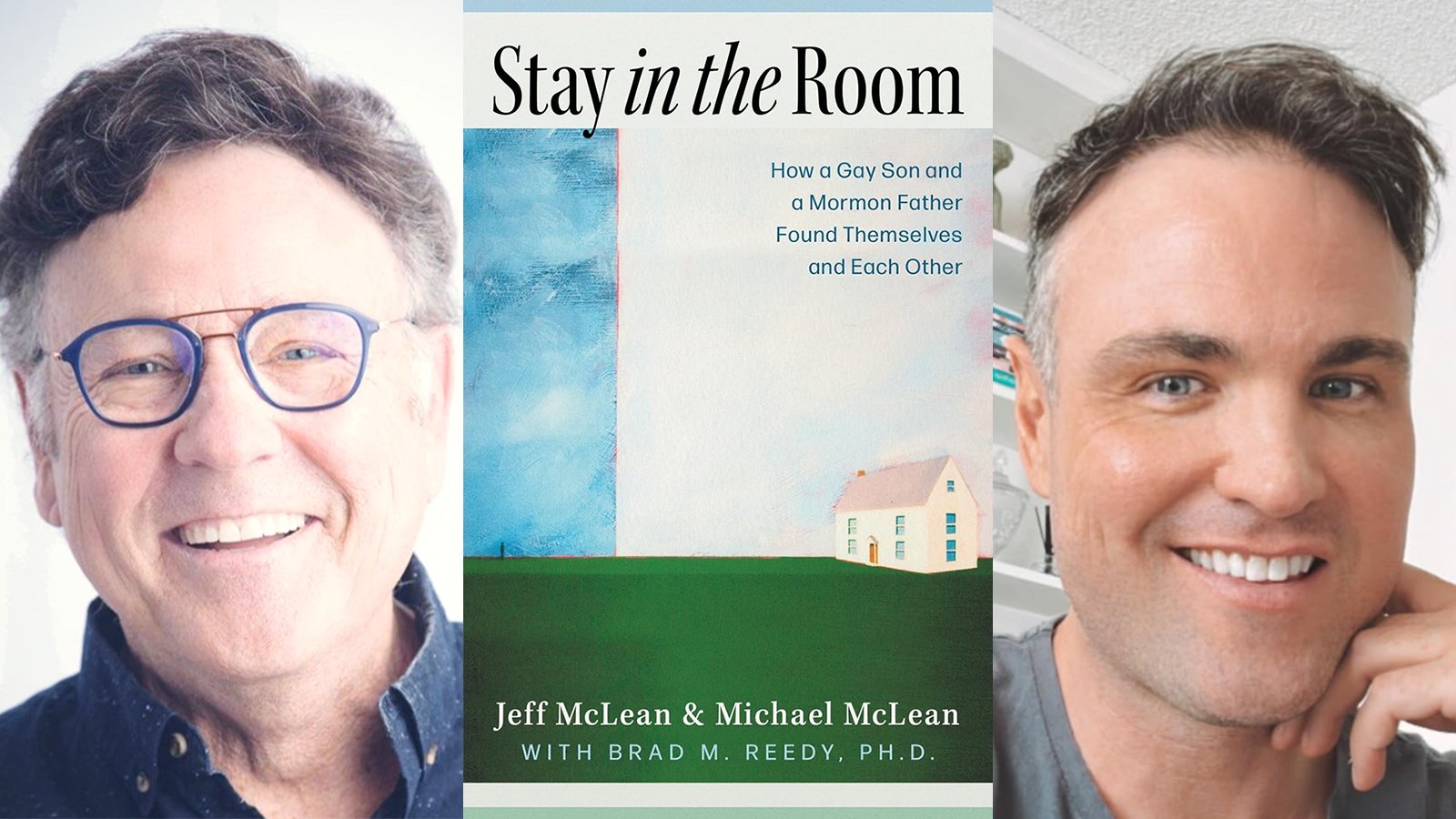
(RNS) — When Jeff McLean was a little baby in the early 1980s, silver-screen icon Jimmy Stewart held him in his arms. And on one of Jeff’s childhood birthdays, theater and movie legend Celeste Holm was there to help celebrate.
Such was life in the McLean family, where music, celebrity and Mormon faith intersected. The stars were on hand because of Jeff’s father, Michael McLean, who made many of the movies and ads for the Church of Jesus Christ of Latter-day Saints in the 1980s and 1990s. Michael was a shining star who also wrote and recorded inspirational music — “Mormonism’s answer to Billy Joel.” He traveled the world performing for thousands and bearing testimony of his religious convictions.
Jeff loved a lot of things about growing up in that orbit. The youngest of the three McLean kids, Jeff was a natural performer and talented singer. He enjoyed touring on the road with his dad and fulfilled many of the church’s expectations for young men: Eagle Scout, mission, BYU. Check, check, check.
But always, Jeff harbored a secret. He was gay — flamingly, utterly, not interested in girls in a romantic way — and his parents just couldn’t or wouldn’t see it. (This despite the fact that when Jeff was 3, he asked for a Strawberry Shortcake doll for Christmas, and his parents outdid themselves by providing not just the doll but the accompanying dollhouse and some of Strawberry’s friends to boot.)

Jeff McLean (left, wearing a girl’s pink dress, shoes, and hat) at age three with older brother Scott. Photo courtesy of Jeff McLean.
Michael says now that he simply had no category for understanding a gay child. In the new book “Stay in the Room,” which he has co-written with Jeff and their therapist, Brad Reedy, Michael says the church had made it clear that being gay was a choice. Also, “God wouldn’t send me a challenge I couldn’t bear. Therefore, my child could not be gay.”

Baptism day. Jeff McLean, left, at age eight with his father. Photo courtesy of Jeff McLean.
Jeff’s mother was in a similar denial. Gayness came from either having a domineering mother, which she was not, or by being molested, which Jeff had not been. So “she determined that I was just a sensitive soul who would make a great husband someday.”
In “Stay in the Room,” Jeff recounts how he learned to hide his gayness as a young man in their uber-Mormon community of Heber City, Utah. The best way to survive, he determined, was to become who everyone else wanted him to be. So he excelled onstage and in musical theater, making audiences weep with joy and the Holy Spirit. Meanwhile, though, he was masturbating constantly, which the church taught was a sin.
Living a double life took a toll, one that only became fully apparent in Jeff’s twenties.
Long story short, he left BYU to record an album, then mostly left the church. He sang and danced on a cruise ship, then in some touring Broadway productions, realizing there was a much bigger world than he’d been taught, and that “the myopic culture that I came from — less than 0.002 percent of the world population, by the way — was trying to put chicken wire around a God of infinite magnitude.” That freedom was exhilarating, but he was also dealing with a lot of rage. He jumped in and out of relationships, hoping to find the One True Man who would make him lovable and banish all his self-doubt. He did some drugs, and then he did a lot of drugs.
Along the way Jeff came out to his family and eventually introduced them to his fiancé. An enduring stereotype of LDS culture is to quickly get engaged to the first person you’ve ever dated seriously. It’s the ticket to adult legitimacy in a marriage-centric world. So, Jeff went all in.
It was 2008, a strange time politically for Jeff to announce his engagement. Michael, who was living in Southern California, was being told at church that same-sex marriage was a dangerous evil that church members needed to combat by passing Proposition 8. Michael wanted to support his son, but also support the prophet. “I was not sold on this being the thing that we should be doing,” he told RNS. “But I did what the church asked me to.”
All the while, Michael was wondering: “Am I betraying Jeff?” There were times, he said, when “I would hear things in church, and I would have to go out in my car and shut the door and scream.”
For his part, Jeff wasn’t that angry about Prop 8. He was busy with his touring company and planning a wedding, and mostly oblivious to the church’s political machinations. But that didn’t mean Jeff wasn’t angry with his dad. In fact, the title of their book references an epic fight that occurred when Michael visited Jeff at a tour stop in Texas, and Jeff shouted at him for nearly an hour. All of the pain from childhood came pouring out, as Jeff screamed that he didn’t care what Michael thought, didn’t want to have anything to do with him; the family had never seen him the way he needed to be seen.
Related: Mormonism and LGBT rights: Some progress, even more questions
Michael’s first instinct was to defend himself from the onslaught, or at least run away. “I’m just thinking, I’ve got to get out of here. I don’t have to listen to this. This is the most awful thing I could ever have imagined.”
But he felt a voice that he identified as the Spirit telling him, “You can’t leave. You have to stay in this room.” His job was to listen to Jeff’s pain — and not just listen so that he’d have ammunition for when it was his turn to talk.
And finally, he heard his son — all the years of pain and loneliness. He felt the pain so keenly that he was able to tell Jeff, “I would hate my guts too” if he’d been the cause.
It was a breakthrough moment, but both father and son are adamant that there have been many ups and downs in their relationship since then. It wasn’t a magical, single moment of reconciliation. In the years that followed, Jeff got divorced, went deeper into drugs and had a long road back to sobriety and the peace he now feels.
Michael changed, too. In fact, Michael went through a nine-year period where God didn’t seem to be answering his prayers. After decades of being a golden child of the church, it was humbling to storm the heavens only to find them silent.
“I’m the guy who sold 2 million records about ‘Hold on, the light will come,” Michael said. “How do I go and tell people I got it all wrong? Do I do a tour that says, ‘Just kidding: You are alone’?”
But Michael came out on the other side of his faith crisis, ultimately recounting the experience in a short video that has been viewed more than 600,000 times on YouTube. Clearly, his vulnerability has struck a nerve.
Related: David Archuleta’s new post-Mormon single is steeped in Mormon beliefs
And Jeff, while no longer participating in the LDS Church, has discovered faith in a much bigger and more loving God than the exacting commanding officer he was taught to believe in. “That God was a judgmental dick,” he laughs. He’s also happily remarried.
Together, father and son hope their story of reconciliation might heal others. They will love each other through thick and thin, and they’ll keep talking, even if sometimes they’re yelling. They will stay in the room. “All I want you to know is that we really do love each other,” Jeff said. “My dad champions me, and I’m his No. 1 fan.”
