
May 04, 2026

Our house is officially sold today. We listed it in late February, and 3 weeks later it was under contract. Today we’re handing the keys to the buyer, and a new family will move into our home and garden of 17 years.
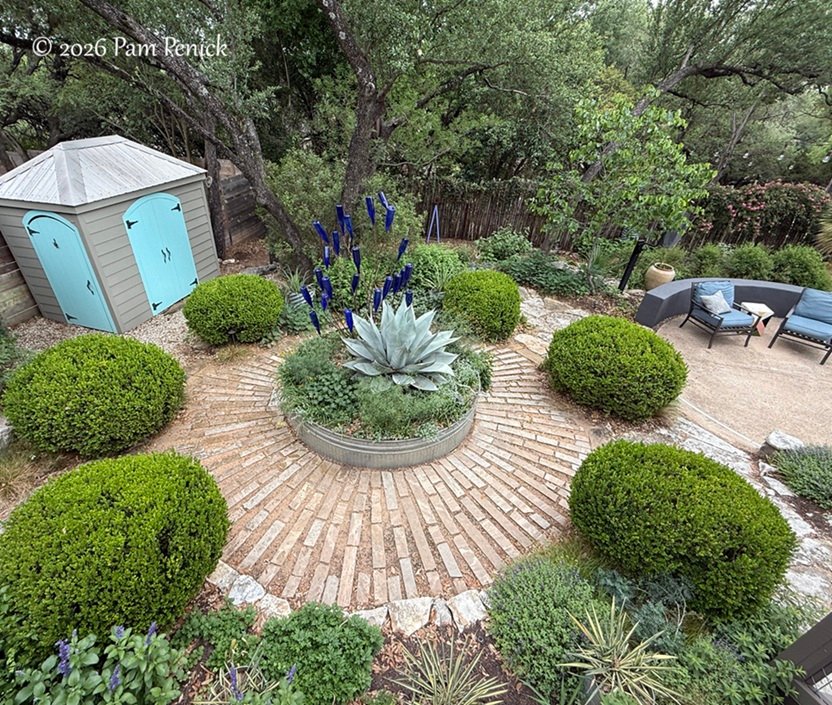
It’s time for a nostalgic spin around the Circle Garden, the oldest part of my garden, where a focal-point 8-foot stock tank has evolved from a lily pond to a raised planter featuring a bottle tree (or bottle ocotillo), wildflowers, seasonal bulbs, and a variegated whale’s tongue agave. It all stays with the house.

Right now one of my favorite Texas wildflowers is blooming, Mexican hat (Ratibida columnifera), alongside four-nerve daisy (Tetraneuris scaposa) and purple coneflower (Echinacea purpurea) — all Texas natives.

I can’t resist Mexican hat’s ballerina-skirt petals in sunset hues and their funny little cone heads.

They have such personality.

Their ferny blue-green foliage is pretty too.

I have a yellow Mexican hat too, with red splotches like droplets of blood. I don’t love this color as much, but it’s still cute.

The whale’s tongue agave (Agave ovatifolia) — aka Ursula, one of my few named plants — flexes her flukes comfortably in the big tank planter.

Yellow Mexican hat with Ursula

And one more. There’s a winecup (Callirhoe involucrata) coming along in there too, but I won’t see it bloom this year. It was a passalong from my friend Diana Kirby.

Pairs of ‘Winter Gem’ boxwood act as gateposts into the Circle Garden. Their clipped spheres and the overall geometry of the space contrast nicely with the wilder plants.
(For the record, I don’t recommend planting boxwood in central Texas currently. While these old Winter Gems have been performers, many of my newer boxwoods have become diseased shortly after planting and had to be removed.)

In the outer ring of the Circle Garden, purple skullcap (Scutellaria wrightii) flowers against ‘Color Guard’ yucca in galvanized pots.

In the back, ‘Mystic Spires’ salvia (Salvia longispicata x farinacea) adds height and season-long flowers.

Here and there, native heartleaf skullcap (Scutellaria ovata) weaves through other plants, adding short spires of blue-purple flowers.

The squid agave (Agave bracteosa) in the tall fluted pot will remain to welcome the new owners.

Behind the swimming pool, rooted in gaps in the limestone slabs, yellow hesperaloe (Hesperaloe parviflora) and beaked yucca (Yucca rostrata) add their own dramatic flower spikes.

The hesperaloe’s yellow flowers pop against the dark cedar coyote fence.

A Tucson-inspired blue stucco wall adds structure and year-round color as a backdrop to blond-flowering Mexican feathergrass (Nassella tenuissima). These are all Texas natives or native cultivars.

One last look at the Circle Garden, which I hope will be a source of joy to the next owner, as it has been for me.
Thank you for following my Texas gardening adventures. I hope you’ll keep following along as I learn about gardening in Colorado and start a new waterwise garden at my future home. Next task: finding and buying a Denver house!
I welcome your comments. Please scroll to the end of this post to leave one. If you’re reading in an email, click here to visit Digging and find the comment box at the end of each post. And hey, did someone forward this email to you, and you want to subscribe? Click here to get Digging delivered directly to your inbox!
__________________________

Digging Deeper
My new book, Gardens of Texas: Visions of Resilience from the Lone Star State, is here! Find it on Amazon, other online book sellers, and in stores everywhere. It’s for anyone who loves gardens or the natural beauty of Texas. More info here.
All material © 2026 by Pam Penick for Digging. Unauthorized reproduction prohibited.
