
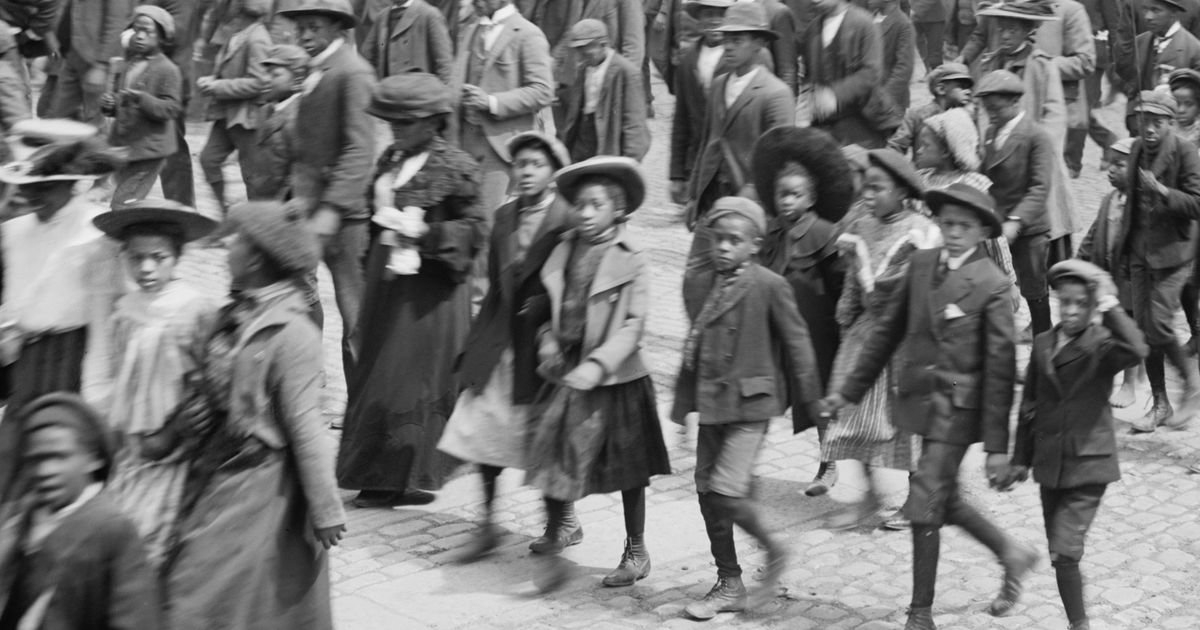

Detail from a photograph of celebrations in Richmond, Virginia, ca. 1905
Photo: Library of Congress
Juneteenth, the celebration of the good news in 1865 that the great abomination of slavery had ended, is a contradictory holiday. It’s joyful in that it commemorates the emancipation of millions of Americans from subhuman legal status. It is sorrowful in that its promise of full citizenship for Black people took so long to realize and still faces so many challenges.
It’s been this way since the original Juneteenth. No sooner had the battle cry of freedom fallen silent than the defeated rebel states devised new laws and customs to tie ex-slaves to the land and subject them to the whip of the overseer and the burning cross of the ex-Confederate terrorist. The Civil Rights Amendments to the Constitution, still controversial today, on paper gave ex-slaves citizenship rights. And Congressional Reconstruction placed the boots of Union soldiers on the necks of the ex-rebels so that Black people could vote and serve in public office. But, eventually, the white people of the North grew tired of Reconstruction and largely hostile to ex-slaves, who were often denied the right to vote in the North and South alike.
By 1877, many white people across the two regions had reconciled. They began framing the terrible war that had liberated the slaves as really a misunderstanding about states’ rights, which meant ex-slaves had no claim on the fruits of victory. With federal protection withdrawn along with sanctions against ex-Confederates, the southern states began to disenfranchise Black (and sometime poor white) voters and institutionalize strict racial segregation (as validated by the U.S. Supreme Court in the 1896 Plessy v. Ferguson decision). By 1910, the white-supremacist regime known as Jim Crow reigned in southern state constitutions and daily practice.
It would take more than half a century before Jim Crow began to collapse. It was an era of occasional advances and frequent reversals of rights and opportunities for Black Americans. For every positive step forward (the New Deal programs, the FDR and Truman equal-employment initiatives, the Supreme Court decisions outlawing segregated public schools, the Civil Rights Act of 1964 dismantling Jim Crow, and the Voting Rights Act of 1965 reenfranchising Black southerners) there were stops and turns and reverses. And with every advance came a national white backlash, which eventually became a calling card for the party of Lincoln. Along with desegregation of schools came “anti-busing” measures and tax-supported “segregation academies.” Along with civil rights and voting rights came ghettoization, militarization of police forces as agents of racial control, mass incarceration, and constant racially fraught battles over government assistance to low-income people. Every token of respect Black people were able to secure was offered grudgingly, contingently, and often with plain bad faith whitewashed by bromides about a color-blind society.
By the time Juneteenth finally became a federal holiday in 2021, the long struggle for racial justice had become a topic of national conversation — but only for a moment. And now we are in the grip of the mother of all white political backlashes. The federal government that waged the Civil War, that freed the slaves (or helped them free themselves), that enacted the Civil Rights Amendments, that overcame the Ku Klux Klan, that slew Jim Crow, that restored the right to vote, is now controlled lock, stock, and barrel across all three branches by people who are working to undermine those achievements.
The institutional crown jewel of the civil-rights movement, the Civil Rights Division of the U.S. Department of Justice, is now devoted almost exclusively to the twin tasks of combating alleged anti-white discrimination and defending the right to discriminate against minority populations on religious grounds. The Congress that passed the Civil Rights and Voting Rights Acts is now focused on facilitating the mass deportation of non-native Americans, mostly nonwhite immigrants and refugees, and transferring resources as rapidly as possible from social programs sustaining the life and health of low-income people to the Pentagon and to wealthy individuals and corporations. The president who lives in the same residence as Abraham Lincoln now rages around the clock at “fraudsters” and “lowlifes” who are allegedly terrorizing our cities and robbing taxpayers, echoing every racist demagogue who ever lived. And the same U.S. Supreme Court that handed down Brown v. Board of Education is now busy emptying the Voting Rights Act of its meaning and urging on efforts to return the South to one-party rule.
As with any great movement, the cause of racial justice will always have its good moments and bad, its days of triumph and of retreat. On this Juneteenth, it’s probably too much to ask that the people running the country — including the president, who is prone to complain that people should not get a day off from work for a holiday commemorating the end of involuntary servitude — share the aspirations of a civil-rights movement they clearly loathe. But at the absolute least, they can give it a rest. Let’s have a day without fresh insults to Black people; a day without a gerrymander, an attack on DEI, a subversion of public schools, a whine about “welfare,” a paean to white nationalism, a call for police or military crackdowns on urban citizens, a celebration of the European peoples “who built this country.” Let the celebrants of Juneteenth take a day to appreciate their accomplishments and their dreams for a better future.
